
Quick Answer: ChatSlide is the AI presentation maker built for gynecologists, OB-GYN residents, and women's health educators. Trusted across 750+ universities and hospital systems, it turns a topic prompt, a society guideline PDF, or an existing deck into a structured, citation-backed gynecology talk in under two minutes — with PubMed, Google Scholar, and clinical-trial search built in, real data charts for outcome and symptom-score data, per-slide speaker notes, and 19 AI editing tools. It's free to start and exports to PowerPoint, PDF, and Keynote.
The Gynecology Presentation Problem
A gynecology talk is rarely about one thing. An endometriosis update has to cover diagnostic delay, imaging versus laparoscopy, medical therapy from combined hormonal options through GnRH analogues and antagonists, surgical decision-making, fertility implications, and long-term pain management — and it has to reconcile society guidance that has moved more than once. A fibroid or abnormal-uterine-bleeding lecture has the same shape: a common condition, several competing treatment pathways, and an audience that will push on every one of them.
The clinical judgement is the part you already have. The part that costs an evening is turning a congress abstract book, a guideline PDF, and a folder of laparoscopic stills into forty coherent slides the week before you present.
What Makes ChatSlide Powerful for Gynecology
Three input modes. Start from a topic prompt ("advances in endometriosis management — diagnosis, medical therapy, surgical options, fertility considerations"), upload an existing PowerPoint to restyle, or drop in a society guideline or congress paper and let ChatSlide draft the outline from it. Gynecology talks usually begin from a guideline — ChatSlide reads it instead of making you retype it.
OCR on uploaded documents. Upload a scanned care pathway, a referral algorithm, or a figure-heavy PDF and ChatSlide extracts the text and images, so your unit's protocol lands in the deck intact.
Real data charts. Gynecology outcomes are numbers: recurrence rates, pain and symptom scores, bleeding-day counts, operative times, fertility outcomes. Turn your own figures into clean charts instead of decorative graphics that misstate the data.
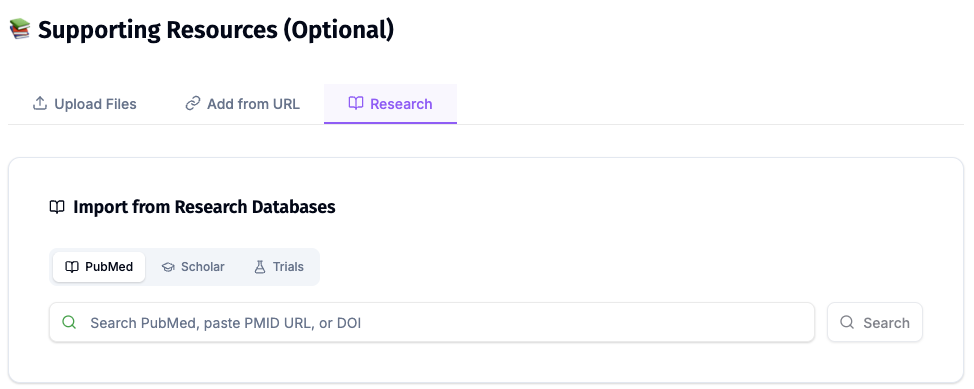
Research search built in. The Research tab queries PubMed, Google Scholar, and ClinicalTrials.gov directly (detailed below), so the trials behind hormonal, surgical, and fertility-sparing recommendations land in your slides with citations — essential for a congress talk or a guideline review.
Speaker notes. ChatSlide drafts per-slide notes, so a resident presenting at a departmental meeting or a first-time congress speaker has a script to work from.
19 AI editing tools. Tighten a dense treatment-comparison slide, generate a diagram of a management algorithm, rephrase a section for a patient audience, or restyle the whole deck to your department's look — without leaving the editor.
How ChatSlide Builds Your Gynecology Deck
1. Start with your topic or source material. A prompt with your learning objectives, an existing deck, or a guideline PDF — ChatSlide reads it and drafts a structured outline.
2. Refine the outline before generating slides. Reorder sections so the talk follows the clinical logic — presentation, diagnosis, medical management, surgical management, fertility and long-term considerations. Fixing structure at the outline stage is far faster than reworking finished slides.
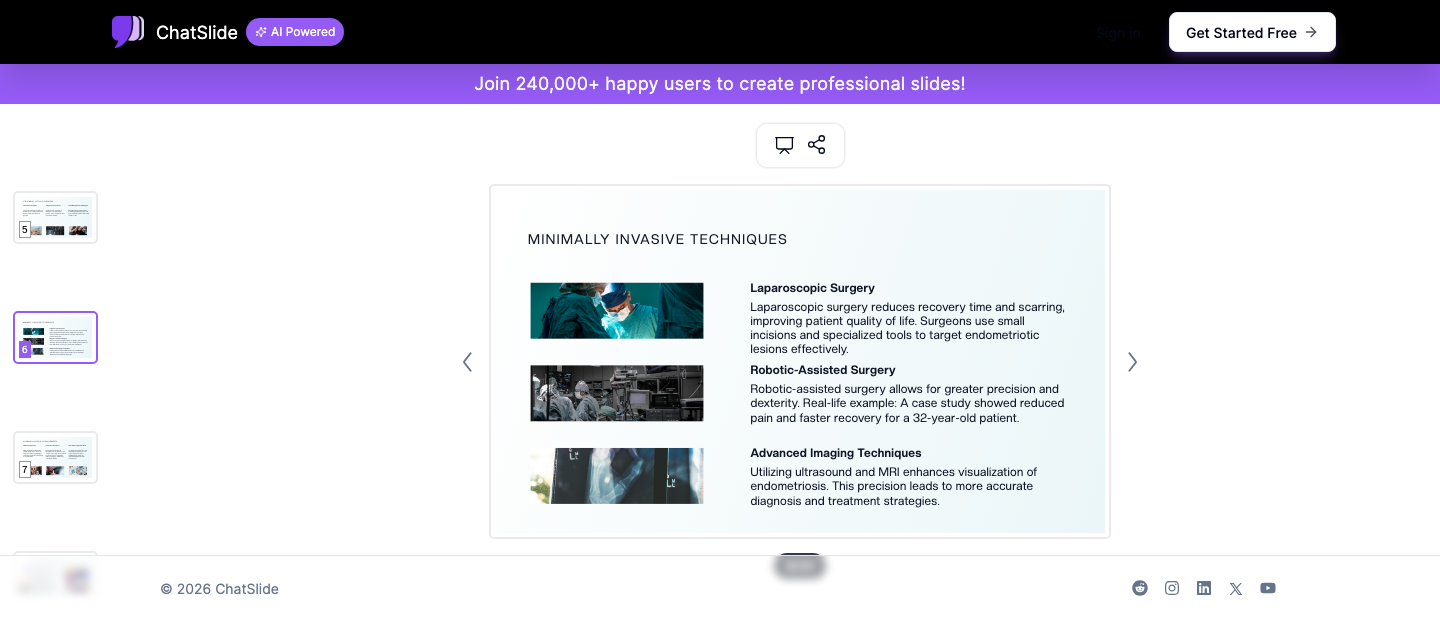
3. Generate slides with relevant imagery and citations. ChatSlide builds each slide with a clean layout and supporting visuals, and can attach trial evidence from the Research tab. Swap any generic image for your own anonymized ultrasound, MRI, or laparoscopic stills.
4. Export to your format. Download as PowerPoint or PDF for departmental teaching, or Keynote for a congress talk.
Use Cases for Gynecology Teams
Congress and society talks. An invited review — endometriosis management, fibroid therapy, menopause care — where structure and citation quality are what the audience remembers. Time saved: an evening of outlining and formatting.
Resident and fellow didactics. Core-curriculum lectures across benign gynecology, minimally invasive surgery, urogynecology, and reproductive endocrinology, built to a consistent template the program reuses. Time saved: a reusable lecture scaffold instead of forty blank slides.
Guideline updates and departmental meetings. A twenty-minute "what changed" talk when society guidance is revised, with the underlying evidence cited beside each change. Time saved: hours pulling and citing evidence.
Surgical technique and M&M teaching. Laparoscopic and robotic approaches, patient selection, complication avoidance — taught from your own anonymized operative images. Time saved: hours reformatting images and tables.
Journal club. Critical appraisal of a hormonal-therapy or surgical trial, with the study design and the practice-changing takeaway on the same slide. Time saved: hours of manual summarizing.
Patient education and clinic materials. Plain-language decks — and narrated video versions — explaining an endometriosis diagnosis, treatment options for heavy bleeding, or what to expect after surgery. Time saved: one clinical deck restyled into a patient-facing version.
Gynecology Presentation AI Tools Compared (2026)
| Capability | ChatSlide | Gamma | Tome | Beautiful.ai |
|---|---|---|---|---|
PubMed / clinical-trial search built in | Yes | No | No | No |
Reads uploaded guideline PDFs & PPTX | Yes | Partial | Partial | No |
OCR on scanned protocols and pathways | Yes | No | No | No |
Real data charts from your own outcome numbers | Yes | Partial | No | Partial |
Per-slide speaker notes | Yes | Partial | No | No |
PowerPoint + Keynote export | Yes | Partial | Partial | Partial |
Free tier | Yes | Yes | Yes | Limited |
Time Comparison: Manual vs. AI-Assisted
| Task | Manual | With ChatSlide |
|---|---|---|
Outline a congress review talk | 1–2 hours | 2 minutes |
Draft slides from a guideline PDF | 3–4 hours | 5 minutes |
Pull and cite trial evidence | 1–2 hours | 10 minutes |
Chart symptom-score or recurrence data | 1 hour | Minutes |
Restyle to department branding | 1–2 hours | Minutes |
What a Strong Gynecology Presentation Includes
The patient's goal stated first. Pain relief, bleeding control, and fertility preservation lead to different pathways for the same pathology. Naming the goal early is what makes the rest of the talk coherent.
Diagnosis with its limits. Imaging findings, laparoscopic confirmation, and symptom-based diagnosis each have a role and a failure mode — a talk that says which is which is more useful than one that presents a single algorithm.
Medical and surgical options side by side. A comparison table of mechanisms, expected effect, side effects, and duration teaches better than sequential slides that never meet.
Evidence attached to each recommendation. Hormonal sequencing, surgical thresholds, and fertility-sparing choices are all contested somewhere — cite the trial or guideline that supports the line you are taking.
Honest operative and imaging material. Anonymized ultrasound, MRI, and laparoscopic stills teach more than stock anatomy renders. Consent and anonymization come first.
Long-term follow-up. Recurrence, contraception, fertility planning, and the transition to menopause care are the parts of the pathway most often dropped for time — and the parts clinic actually runs on.
Best Practices (Do's and Don'ts)
Do open with the patient presentation as it actually arrives in clinic, then reason forward to the pathway.
Do put each treatment algorithm on one slide the audience can hold in their head, with detail on backup slides.
Do distinguish established practice from areas of genuine debate — the audience will ask, and the honest slide is the memorable one.
Do anonymize every image and case detail before it goes into a deck, including dates and identifiers burned into ultrasound or operative captures.
Don't paste a whole guideline table onto one slide — split it into the decision it drives.
Don't use stock anatomy illustrations where your own anonymized imaging or an outcome chart would actually teach.
Don't end at the intervention. Recurrence risk, fertility implications, and follow-up are the decisions the audience takes back to clinic.
Direct Research Database Access
ChatSlide's Research tab connects to the databases physicians use daily:
- PubMed: Search by keyword, PMID, or DOI. Find the landmark trials, recent publications, and clinical guidelines relevant to your case. The AI reads abstracts and incorporates key findings into your slides with citations.
- Google Scholar: When your topic spans disciplines — say, the intersection of genetics and oncology — Scholar captures the broader academic literature that PubMed alone might miss.
- Clinical Trials (NCT): Presenting on a treatment where pivotal trials are ongoing? Search by NCT number or condition to pull trial design, endpoints, and status into your slides.
Gynecology for Departments, Residencies, and Women's Health Services
For an OB-GYN department, a residency program, or a women's health service line, ChatSlide scales past the individual lecturer. Shared brand templates keep every resident's teaching session and every faculty lecture consistent, team collaboration lets attendings review trainees' decks before they present, and centralized billing plus SSO simplify rollout across a department. Decks can also be exported as narrated video for an on-demand teaching library or a clinic patient-education series.
For patient data specifically: ChatSlide's standard plans are not a HIPAA-covered service — keep protected health information (PHI) out of slide content and uploads, and anonymize case details and imaging before they go in a deck. For hospital systems, group practices, and clinics that need a Business Associate Agreement, our Enterprise plan offers HIPAA-compliant deployment options — contact us to discuss BAA terms, SSO, and on-prem / private-cloud hosting.
Frequently Asked Questions
Can ChatSlide build slides from a guideline or an existing PowerPoint? Yes. Upload a guideline, a protocol, a congress paper, or an existing deck, and ChatSlide reads the content — including scanned documents via OCR — then drafts a structured outline you can refine before generating slides.
Does it add real citations? Yes. The Research tab queries PubMed, Google Scholar, and ClinicalTrials.gov, so the trials behind hormonal and surgical recommendations land in your deck with citations.
Can it build a case presentation from my notes? Yes. Paste or upload your case summary and ChatSlide structures it into presentation, workup, differential, and management sections you can refine — just anonymize it first.
Can I use my own ultrasound or laparoscopic images? Yes. Swap any generated image for your own anonymized figures in the editor.
Is it free? You can start for free. Free decks are watermarked and viewable or shareable online; PDF, PowerPoint and Keynote export are on the paid tiers.
Is it HIPAA compliant? The standard plans are not a HIPAA-covered service — keep PHI out and anonymize cases. Enterprise offers HIPAA-compliant deployment options and a BAA; contact us to discuss.
What formats can I export? PowerPoint, PDF, and Keynote.
Related Guides
This guide covers benign and general gynecology — endometriosis, fibroids, abnormal uterine bleeding, and gynecologic surgery teaching. For IVF, egg freezing, and pre-conception counseling, see our fertility and reproductive health guide. For intrapartum and obstetric topics, see the labor and delivery presentation guide, and for gynecologic cancer teaching, the oncology and hematology presentation guide.
Get Started
Gynecology asks clinicians to hold a diagnosis, several competing treatment pathways, and a fertility conversation in one talk — and then deliver it to residents, congress audiences, and patients. The hours spent formatting slides are hours away from that work.
With ChatSlide, turn your expertise in endometriosis, fibroids, and minimally invasive gynecologic surgery into structured, citation-backed slides in minutes — whether you're presenting at a society congress, running departmental teaching, or building patient-facing material for clinic.
Make your gynecology presentation with ChatSlide — free to start, no credit card required.