
Quick Answer: If you teach a cancer biology or tumor biology course and need lecture slides on the hallmarks of cancer, oncogenes and tumor suppressors, the tumor microenvironment, or invasion and metastasis, ChatSlide turns a topic or a source document into a structured deck in minutes. It is used by 290,000+ users across 750+ universities, builds outlines that follow real teaching logic, adds relevant figures, can pull supporting literature from PubMed and Google Scholar, and exports to PowerPoint for the lecture hall. Free to start, no card required.
The Cancer Biology Slide Problem
Cancer biology is a course that has to hold two altitudes at once. A single lecture moves from a point mutation in a growth-factor receptor, to a clone acquiring a capability, to a tumor behaving as a tissue, to why a targeted drug works for eleven months and then stops. Miss the connective tissue between those levels and students memorize a hallmark list without ever seeing why the list exists.
It is also a course that gets rebuilt constantly. The mechanisms are stable, the examples are not. Immune-checkpoint content that was a closing footnote a few years ago is now a full lecture; microenvironment and metabolic reprogramming have gone from optional to core. Instructors end up carrying a lecture series across terms, splitting long topics into Part 1 / Part 2, and rewriting the same scaffolding each time.
Generic AI slide tools do poorly here. They will produce a clean-looking slide that says cancer is "a complex disease with many causes" instead of showing that a driver mutation creates a specific capability, that the capability is context-dependent, and that the context is what therapy has to contend with. In a teaching deck, that causal chain is the content.
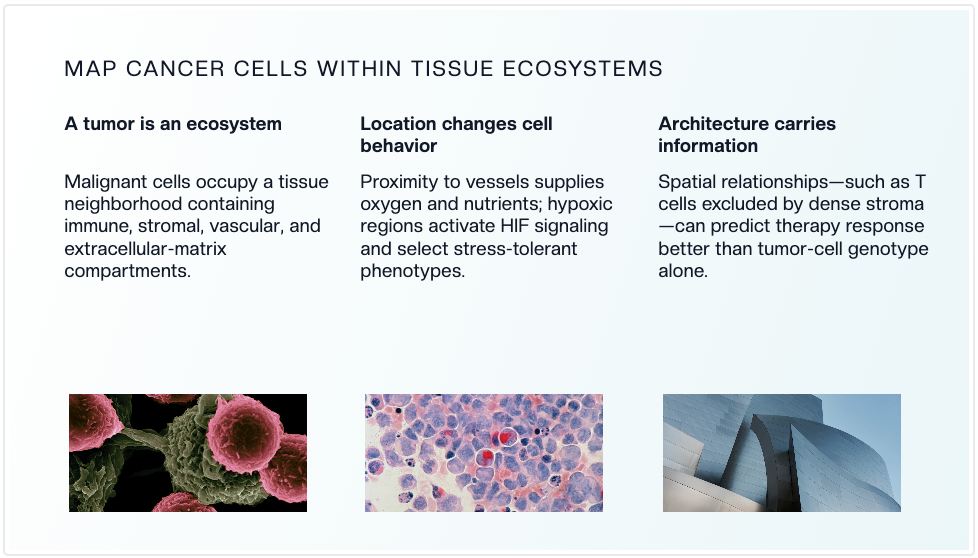

This page is for cancer biology / tumor biology course intent. If your material is molecular genetics, gene expression, or RNA technology, see our molecular biology presentation guide. If you are presenting cancer treatment — regimens, tumor board, trial data — see the oncology and hematology presentation guide.
What Makes ChatSlide Powerful for Cancer Biology
1. Multiple input modes for course material
Some lectures start from a topic prompt like "Tumor microenvironment: stroma, vasculature, and immune contexture." Others start from a review article PDF, a textbook chapter, or last term's deck that needs rebuilding around new content. ChatSlide works from a topic, an uploaded document, or a pasted outline, which matters because cancer biology material rarely arrives in one format.
2. Outlines that preserve mechanism
The outline stage is editable before any slide is generated. That is where a cancer biology lecture is won or lost: you can enforce the sequence you actually teach — genotype, capability, tissue context, therapeutic consequence — rather than accepting a flat list of topics. Reorder, merge, split, or delete sections, then generate.
3. Figures that carry the science
Micrographs, histology, cell-signaling visuals, and diagram-style images are inserted per slide rather than as decoration on the title page. You can swap any image, and generate one from a description when the concept is abstract — clonal evolution, immune exclusion, an EMT gradient — and no stock photo exists for it.
4. Literature pulled in at draft time
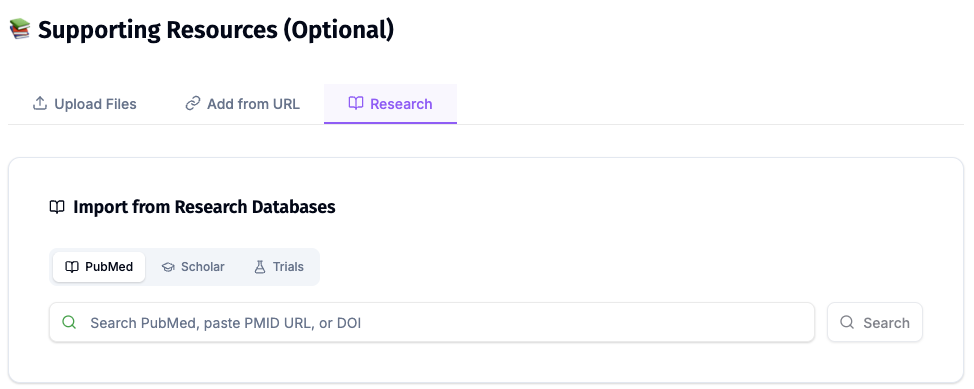
The Research tab searches PubMed and Google Scholar from inside the editor. For a course that cites landmark papers by name, this removes the tab-switching loop: search the mechanism, pull the abstract, let the AI incorporate the finding into the slide with a citation attached.
5. Speaker notes written against the slide
Notes are generated per slide, which is what makes a deck reusable next term and handable to a co-instructor or TA. For a lecture series, this is the difference between slides you can lend and slides only you can deliver.
6. Long topics split without losing the thread
Cancer biology topics routinely overflow one session — microenvironment, metastasis, and tumor immunology all tend to become Part 1 / Part 2. Generating from the same source material with a narrowed outline keeps terminology, figure style, and structure consistent across parts instead of drifting.
7. Export where you teach
PowerPoint, PDF, and Google Slides export, plus a shareable link for students who want the deck after class. The PPTX comes out editable, so departmental templates and last-minute edits still work.
How ChatSlide Builds Your Cancer Biology Lecture
Step 1 — Give it the source. A topic sentence ("Invasion and metastasis: adhesion, EMT, and the metastatic cascade"), a review PDF, or an existing deck. Scanned chapters are read with OCR, so an older photocopied figure set is still usable input.
Step 2 — Shape the outline. Set the audience level — undergraduate survey, majors course, graduate seminar — and edit sections directly. This is the fastest place to enforce teaching order and to cut what belongs in a different lecture.
Step 3 — Generate slides with figures. Slides are built with titles, structured body content, and relevant images. Charts can be generated from real data if you are showing survival curves, incidence trends, or response rates.
Step 4 — Refine and export. Use the editing tools to tighten wording, add citations from PubMed, regenerate an image, or rebalance a slide that is carrying too much text. Then export to PowerPoint.
Use Cases for Instructors and Students
Undergraduate survey lecture. The challenge is altitude: enough mechanism to be real, not so much that a non-majors audience drowns. Generating at survey level and then adding two mechanism slides is faster than writing down from a graduate deck. Saves roughly 3-4 hours per lecture.
Majors-level course series. A ten-to-fourteen lecture cancer biology sequence — molecular foundations, cell-cycle and apoptosis circuits, microenvironment, angiogenesis, invasion and EMT, tumor immunology — built from the same source set so terminology and figure style stay consistent across the term.
Graduate seminar. Paper-driven sessions where the deck exists to frame a discussion. Pull the primary literature via the Research tab, build six to eight slides that state the claim, the evidence, and the open question, and leave the rest to the room.
Student journal club and lab meeting. Students presenting a cancer biology paper need a defensible structure — background, question, approach, key figures, limitations — more than they need design. The outline stage supplies that structure.
Departments and teaching teams. Where a course is co-taught or repeated across sections, shared brand templates, team collaboration, SSO, and centralized billing keep decks consistent across instructors. Contact us about Enterprise if you are rolling this out for a department or program.
Cancer Biology AI Tools Compared (2026)
| Capability | ChatSlide | Gamma | Tome | Beautiful.ai |
|---|---|---|---|---|
Build from an uploaded review article or chapter | Yes, with OCR | Limited | Limited | No |
PubMed / Google Scholar search inside the editor | Yes | No | No | No |
Per-slide scientific figures | Yes | Generic imagery | Generic imagery | Template imagery |
Generate a figure from a description | Yes | Limited | Limited | No |
Editable outline before generation | Yes | Partial | Partial | No |
Speaker notes per slide | Yes | Partial | Partial | Limited |
Editable PowerPoint export | Yes | Yes | Limited | Yes |
Free tier | Yes | Yes | Yes | Trial only |
Time Comparison: Manual vs. AI-Assisted
| Task | Manual | With ChatSlide |
|---|---|---|
Structuring the lecture | 45-60 min | 10 min (edit outline) |
Writing slide content | 2-3 hours | 5 min (generated) |
Finding and placing figures | 60-90 min | 10 min (swap a few) |
Pulling supporting literature | 45 min | 10 min (Research tab) |
Writing speaker notes | 45 min | 10 min (review) |
Total per lecture | 5-7 hours | 45-60 min |
What a Strong Cancer Biology Lecture Includes
- A causal spine, not a list. Hallmarks land when each one is introduced as a capability a clone had to acquire, with the alteration that grants it and the constraint it overcomes.
- Genotype tied to phenotype tied to therapy. A driver mutation, the capability it sustains, the drug that blocks it, and the resistance that follows — the arc that makes the mechanism worth learning.
- The tumor as a tissue. Stroma, vasculature, immune contexture, hypoxia. Students who only ever see the cancer cell cannot explain why immunotherapy works in some tumors and not others.
- Real figures. Histology, micrographs, and signaling diagrams do work that prose cannot. A cancer biology slide with no image is usually a slide carrying too much text.
- Named evidence. Landmark papers and pivotal trials cited by name give students something to read and give the claim a provenance.
- A closing question. Seminar-level sessions should end on the unresolved part, not a summary of what was just said.
Best Practices
Do:
- Set the audience level explicitly at the outline stage — survey, majors, and graduate versions of the same topic are genuinely different decks.
- Split overflowing topics into Part 1 / Part 2 from the same source material so the terminology stays consistent.
- Replace any figure that is only thematically related. Literal-match image selection is the most common weak spot in an auto-generated science deck, and it takes seconds to fix.
- Check every mechanism and every number against the primary source before you teach it. AI-generated slides are a first draft with a strong structure, not a verified one.
- Keep one slide per idea. If a slide has three mechanisms on it, it is three slides.
Don't:
- Don't put identifiable patient data, case images, or unpublished collaborator data into slide content or uploads. Use published, de-identified examples for teaching material.
- Don't present a hallmark framework as settled and complete — say which parts are contested, especially around metabolism and immune evasion.
- Don't reuse a figure without checking its license and attribution requirements for classroom or public distribution.
Pulling in Primary Literature
The Research tab searches PubMed and Google Scholar from inside the editor, so the landmark papers behind a mechanism can be found, read, and cited without leaving the deck. For a cancer biology course this is most useful at the seminar end — pulling the specific study that established a claim, rather than restating a textbook summary of it.
Frequently Asked Questions
Can it build a whole lecture series, not just one deck? Yes. Generate each lecture from the same source set with its own outline. Terminology, structure, and figure style stay consistent across the series, which is what makes a multi-part course feel like one course.
Will it handle a scanned textbook chapter? Yes. Uploads are read with OCR, so scanned chapters and older photocopied figure sets work as input.
Can it make figures for concepts with no stock photo — clonal evolution, immune exclusion? Yes. You can generate an image from a description and place it on the slide, then swap it if it does not read clearly at lecture-hall distance.
Does it cite sources? Citations can be attached when content is drawn from the Research tab. Verify each one against the source before teaching from it.
Is the PowerPoint export editable? Yes. The PPTX opens as normal editable slides, so departmental templates and last-minute edits still work.
How is this different from your oncology guide? This page is for cancer biology as a science course — hallmarks, oncogenes and tumor suppressors, microenvironment, metastasis. The oncology and hematology guide is for clinical practice: regimens, tumor board, and trial data.
Can students use it for journal club? Yes. The free tier covers a typical student presentation, and the outline stage supplies the background-question-evidence-limitations structure a good journal club deck needs.
Is there a version for departments? Yes. Enterprise adds SSO, centralized billing, shared brand templates, and team collaboration for co-taught or multi-section courses. Contact us to discuss it.
Get Started
Cancer biology decks are slow to build because the science is layered, not because the science is unclear. The mechanism is already in your head — the hours go into assembly, figure hunting, and rebuilding the same scaffolding each term.
Make your cancer biology lecture with ChatSlide — free to start, no card required. Bring a topic, a review article, or last term's deck, and have a structured, figure-supported draft to edit in minutes instead of an evening.