
The Challenge of Teaching Clinical Nutrition
Clinical nutrition sits at the intersection of biochemistry, physiology, pharmacology, and bedside care — and a single dietetics lecture often has to span all of it. A session on medical nutrition therapy (MNT) in chronic kidney disease has to connect protein and potassium restriction to lab values, dialysis modality, and the patient's actual plate. A lecture on nutrition after bariatric surgery has to move from altered anatomy to micronutrient supplementation to long-term monitoring. The content is dense, and the audience — dietetic interns, students, and practicing clinicians — expects both rigor and clarity.
The difficulty isn't expertise. Registered dietitians and dietetics faculty know this material deeply. The problem is turning it into slides that move an audience cleanly from nutrient metabolism to assessment to a concrete intervention — without burying the key message under a wall of numbers or a cluttered food-exchange table.
Generic presentation templates make this harder. They have no concept of a nutrition-focused physical exam, a malnutrition screening tool, or a side-by-side comparison of enteral formulas. The result is usually a compromise between nutritional accuracy and visual clarity, and a long evening spent formatting instead of teaching.
This guide focuses on clinical nutrition and dietetics education specifically — medical nutrition therapy, disease-specific diet planning, nutrition assessment, and the risk and quality dimensions of dietetics practice. If your topic is the pharmacology of weight management — GLP-1 agonists, metabolic-bariatric surgery decisions, or obesity-medicine board review — see our companion guide on obesity medicine and GLP-1 presentations instead.
What Makes a Strong Clinical Nutrition Presentation
The dietetics lectures that hold an audience share a few traits.
The nutrition care process as a backbone. Strong MNT teaching follows the clinical reasoning dietitians actually use: assessment, nutrition diagnosis, intervention, and monitoring and evaluation. Structuring a lecture around this arc mirrors how clinicians think and gives students a transferable framework rather than a list of facts.
Disease physiology tied to the diet. A renal nutrition lecture is only useful when the audience can see why potassium and phosphorus matter — the failing kidney's handling of each, the lab thresholds that trigger action, and the foods that move the numbers. The best slides connect mechanism directly to the intervention.
Assessment tools made visual. Validated malnutrition screening and assessment tools, anthropometrics, and biochemical markers are the backbone of nutrition diagnosis. Each is clearer as a labeled framework or a worked example than as a dense paragraph.
Practical, plate-level translation. Dietetics is ultimately applied. A lecture that ends in a sample meal pattern, an exchange list, or a counseling script lands far better than one that stops at the biochemistry. Showing the food, not just the nutrient, is what students remember.
Where Clinical Nutrition Presentations Show Up
Dietetics didactics and coursework. Core lectures walking students through MNT for each major condition — renal disease, diabetes, cardiovascular disease, GI disorders, and surgical nutrition.
Dietetic internship and clinical rotations. Case-based teaching that connects a patient's labs and diet history to a specific nutrition diagnosis and intervention.
Risk and quality management in practice. Sessions on food safety, allergen management, documentation standards, and quality improvement in clinical and foodservice settings.
Continuing professional development. Updates on evolving guidelines — protein targets in critical illness, micronutrient monitoring after bariatric surgery, or new evidence in enteral and parenteral nutrition.
Patient and group education. Counseling material for outpatient clinics, diabetes education classes, and community nutrition programs.
In-services for the care team. Short, focused decks that bring nurses, physicians, and other staff up to speed on a nutrition protocol.
Building Your Presentation with ChatSlide
Step 1: Define Your Topic Precisely
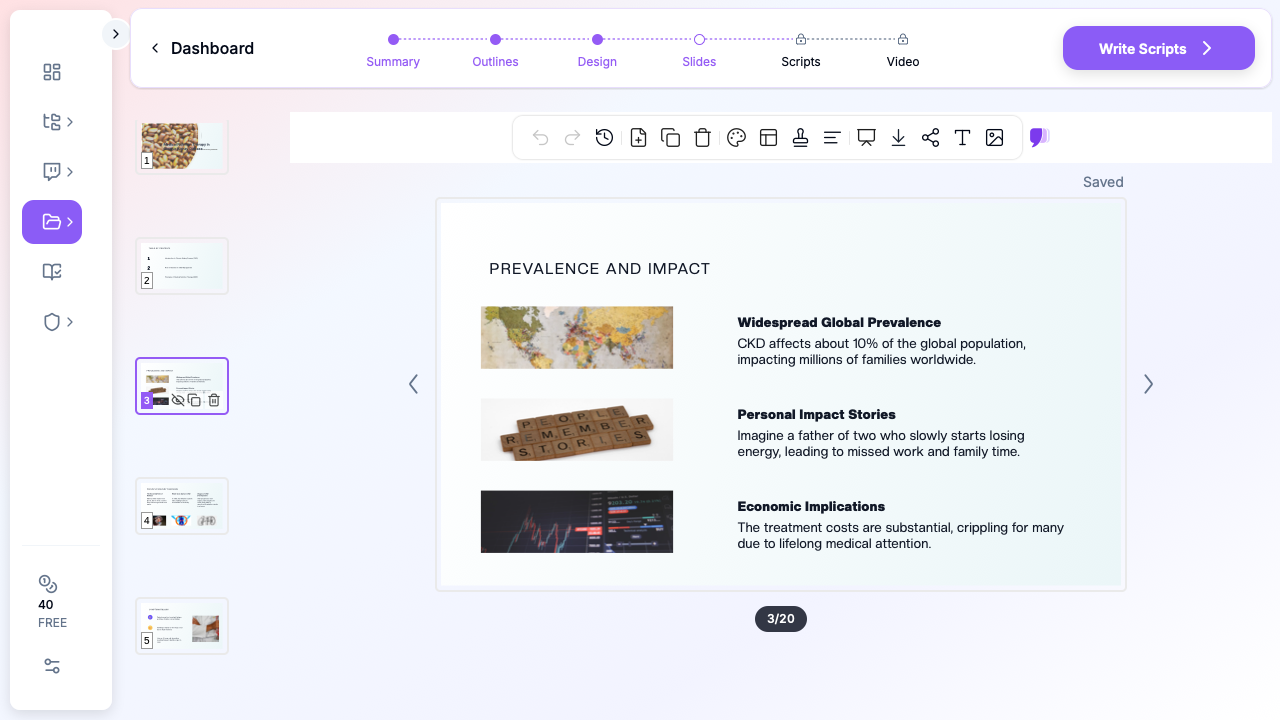
Open ChatSlide and describe your subject with as much specificity as possible. Precise prompts produce precise slides. For example:
- "Medical nutrition therapy in stage 4 chronic kidney disease: protein, potassium, and phosphorus management"
- "Nutrition management after bariatric surgery: progression of diet stages and lifelong micronutrient supplementation"
- "Risk and quality management in clinical dietetics: documentation, food safety, and allergen control"
Specify your audience too. A first-year dietetics lecture assumes less background than a clinical-rotation case discussion and should spend more time on fundamentals.
Step 2: Structure Your Clinical Argument
ChatSlide generates a structured outline covering the essentials of your topic. For a renal nutrition lecture, that might include:
- Pathophysiology of chronic kidney disease and its nutritional consequences
- Nutrition assessment in renal patients
- Protein, sodium, potassium, and phosphorus management
- Adjustments by CKD stage and dialysis modality
- Sample meal patterns and patient counseling
- Monitoring, labs, and follow-up
Adjust the outline to your audience. If your listeners already know the physiology, compress that section and expand the practical meal-planning and counseling discussion.
Step 3: Import Evidence with Built-In PubMed Search
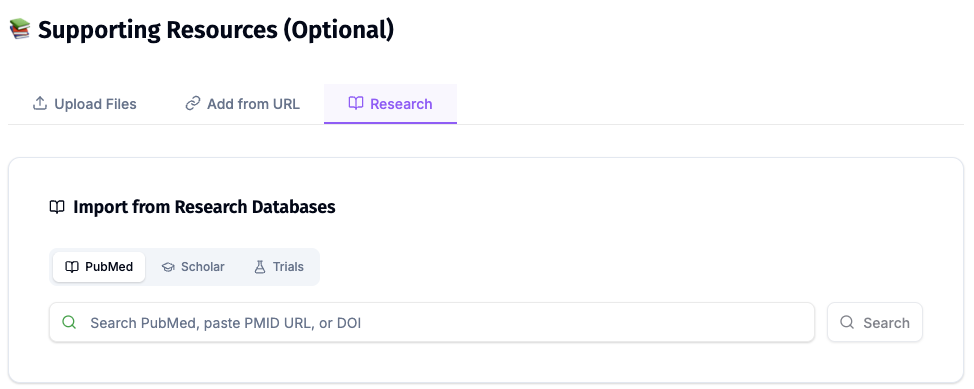
ChatSlide's Research tab lets you search PubMed, Google Scholar, and ClinicalTrials.gov without leaving the platform. Pull current clinical practice guidelines, landmark nutrition trials, and recent systematic reviews directly into your deck — with citations — rather than juggling browser tabs and reference managers.
Step 4: Build Content-Rich Slides
Once the outline is set, ChatSlide produces a complete slide deck with professional formatting. Each slide concentrates on a single idea, which keeps a dense subject legible and gives you a clean structure to narrate.
Step 5: Add Your Own Cases and Protocols
The AI supplies the structure and core content; the strongest clinical nutrition talks add the presenter's own material. Enrich the deck with:
- De-identified patient cases and diet histories from your practice
- Your institution's nutrition screening and documentation protocols
- Local formulary details — enteral formulas, supplements, and meal patterns you actually use
- The specific clinical guidelines your program follows
Direct Research Database Access
ChatSlide's Research tab connects to the databases physicians use daily:
- PubMed: Search by keyword, PMID, or DOI. Find the landmark trials, recent publications, and clinical guidelines relevant to your case. The AI reads abstracts and incorporates key findings into your slides with citations.
- Google Scholar: When your topic spans disciplines — say, the intersection of genetics and oncology — Scholar captures the broader academic literature that PubMed alone might miss.
- Clinical Trials (NCT): Presenting on a treatment where pivotal trials are ongoing? Search by NCT number or condition to pull trial design, endpoints, and status into your slides.
Tips for Clinical Nutrition Presentations
Anchor each topic in a patient. Open a renal nutrition lecture with a real-feeling case — the labs, the diet recall, the social context — before the physiology. It gives the audience a clinical frame for everything that follows.
Connect every nutrient to a consequence. Don't just list a potassium restriction; show what hyperkalemia does and which foods drive it. Cause-and-effect framing is what makes nutrition rules stick.
Translate to the plate. End each MNT section with a sample meal pattern, an exchange swap, or a counseling phrase. Applied examples turn abstract targets into something students can actually teach a patient.
Keep tables legible. Food-composition and exchange tables are easy to overload. Show only the rows that make your point on the slide, and reserve the full table as a handout or backup.
Prepare for detailed questions. Dietetics audiences probe protein targets, micronutrient dosing, and the evidence behind guideline thresholds. Have backup slides ready with supplementary tables and references.
A Note on Patient Data
ChatSlide's standard plans are not a HIPAA-covered service — keep protected health information (PHI) out of slide content and uploads, and de-identify any patient cases, diet histories, or lab values you present. For hospital systems, academic medical centers, and group practices that need a Business Associate Agreement, our Enterprise plan offers HIPAA-compliant deployment options — contact us to discuss BAA terms, SSO, and on-prem / private-cloud hosting.
Get Started
Clinical nutrition teaching builds the reasoning that turns biochemistry into better patient care, and trains the next generation of registered dietitians. The hours spent formatting slides are hours away from that work.
With ChatSlide, turn your expertise in medical nutrition therapy, renal and surgical nutrition, and dietetics practice into structured, professional slides in minutes — whether you're delivering a core didactic lecture, teaching on a clinical rotation, or running a continuing-education session.
Start building your clinical nutrition presentation with ChatSlide.