The Challenge of Presenting Longevity and Metabolic Health
Longevity medicine asks an audience to hold several layers at once. A single keynote on metabolic health has to connect mechanism — mitochondrial function, insulin signaling, chronic inflammation — to the lab markers a clinician orders, the lifestyle levers a patient can actually pull, and the long-arc outcome everyone cares about: more healthy years, not just more years. The field sits between molecular biology and the dinner plate, and a good talk has to travel that whole distance without losing the room.
That breadth is exactly what makes the slides hard. A talk on the effects of chronic stress on human physiology has to move from the HPA axis to mitochondrial energetics to the practical question of what a stressed-out patient does on Monday morning. A talk on metabolic health and longevity has to make abstract concepts — metabolic flexibility, healthspan versus lifespan, biological age — feel concrete enough that a mixed audience of clinicians, health coaches, and motivated patients can follow along. The expertise is rarely the bottleneck. Turning it into a clean visual arc is.
Generic presentation templates do not help. They have no concept of a longevity biomarker panel, a metabolic-flexibility curve, or a lifestyle-intervention pyramid. So practitioners end up either dumping dense biochemistry onto a slide or oversimplifying into wellness platitudes — and spending an evening formatting instead of refining the message.
This guide focuses on longevity, metabolic health, and functional/preventive medicine presentations specifically. If your topic is the clinical pharmacology of weight management — GLP-1 agonists, metabolic-bariatric surgery decisions, or obesity-medicine board review — see our companion guide on obesity medicine and GLP-1 presentations. If you teach the nutrition side — medical nutrition therapy and disease-specific diet planning — see the clinical nutrition and dietetics guide.
What Makes a Strong Longevity & Metabolic Health Presentation
The longevity talks that actually land share a few traits.
Healthspan, not just lifespan, as the through-line. The most compelling framing in this field is the gap between how long people live and how long they live well. Anchoring a talk on compressing that gap — on adding healthy years — gives the audience a reason to care before the biochemistry arrives.
Mechanism tied to a lever the audience can pull. A slide on mitochondrial health or insulin resistance is only useful when it connects to something actionable: sleep, movement, nutrition, stress, or a specific marker to track. The strongest decks pair every mechanism with the intervention that moves it.
Biomarkers made legible. Longevity and metabolic medicine runs on panels — fasting insulin, HbA1c, hs-CRP, ApoB, VO2 max, grip strength, biological-age estimates. Each is far clearer as a labeled framework, a reference-range visual, or a worked example than as a wall of numbers.
Honest about the evidence. This is a field with strong signal and a lot of hype. Talks that distinguish established physiology from emerging hypotheses — and cite their sources — build credibility that wellness-flavored decks never earn.
A story or case to carry it. Whether it is a composite patient, an athlete's trajectory, or a population-level trend, a concrete narrative gives the audience a place to attach the abstract concepts.
Where Longevity & Metabolic Health Presentations Show Up
Conference keynotes and longevity summits. Thought-leadership talks framing metabolic health, healthspan, and aging biology for a mixed professional audience.
Functional and integrative medicine teaching. CME, practitioner training, and clinic in-services on root-cause approaches to metabolic dysfunction, chronic stress physiology, and lifestyle interventions.
Preventive and lifestyle medicine. Decks for primary-care and lifestyle-medicine clinicians translating metabolic science into counseling that changes behavior.
Patient and community education. Approachable talks for motivated patients, corporate-wellness audiences, and health-coaching clients — high on clarity, careful with claims.
Research and journal-style updates. Lab meetings and review talks summarizing the aging-biology, mitochondrial, and metabolic literature.
Step-by-Step: Building Your Presentation with ChatSlide
1. Start from your topic or your source material. Describe your talk — "metabolic health and longevity for a clinician audience" or "chronic stress, the HPA axis, and mitochondrial health" — or upload what you already have: a review article, a PDF of your notes, a spreadsheet of biomarker data, or an earlier deck. ChatSlide reads the material and proposes a structured outline.
2. Shape the outline around a healthspan arc. Edit the generated outline so it moves cleanly: the healthspan problem, the underlying physiology, the markers that reveal it, the levers that change it, and the practical takeaways. Reorder, merge, or rewrite sections before any slides are built — it is far faster to fix the structure here than later.
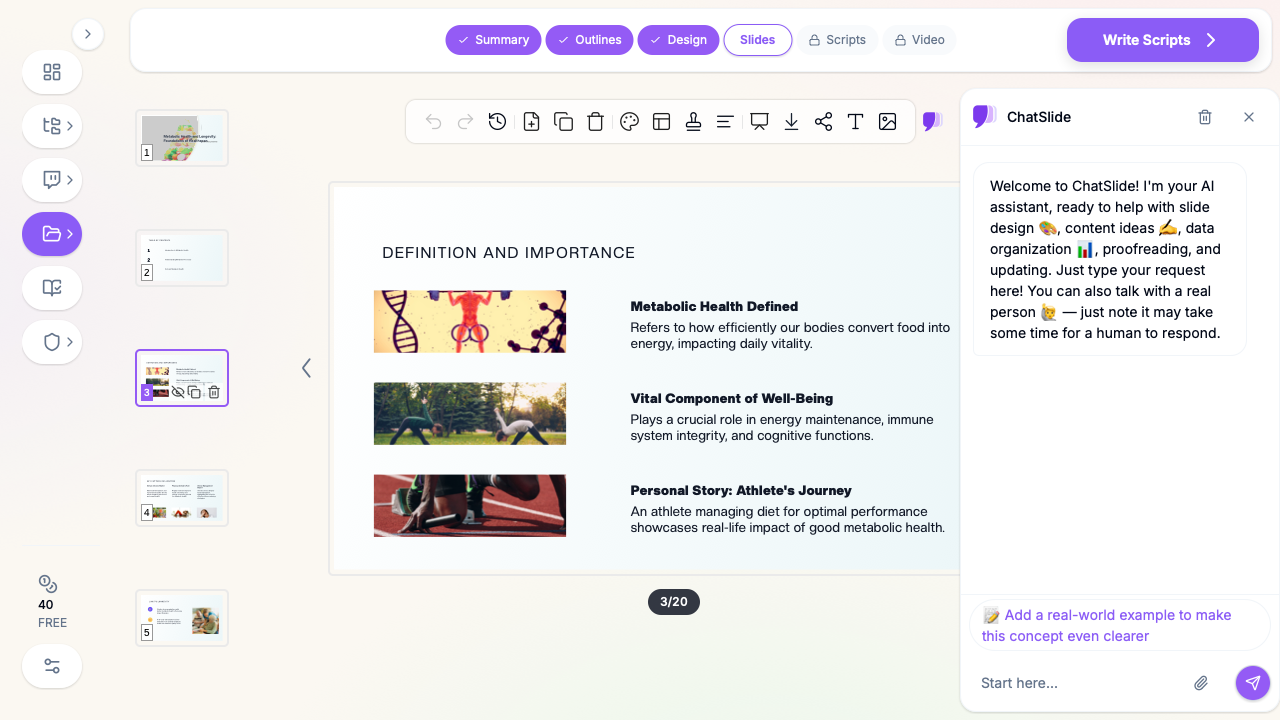
3. Generate slides with mechanism and intervention paired. ChatSlide turns each outline section into a slide with a clear hierarchy — a headline claim, supporting points, and room for a visual. Because the structure is set first, the biochemistry stays tied to the action rather than floating free.
4. Add visuals that carry the science. Use the image tools to bring in supporting imagery, and lean on charts for the data — a metabolic-flexibility curve, a biomarker trend, a healthspan-versus-lifespan comparison. A labeled visual does more for comprehension than another bullet list.
5. Ground it in the literature. Pull citations directly from the research databases below so claims about mitochondrial function, insulin resistance, or lifestyle interventions are anchored to sources — not asserted.
6. Refine with the chat assistant. Ask it to tighten a dense slide, add a summary, simplify a section for a patient audience, or generate speaker notes. Then export to PowerPoint, Google Slides, or PDF, or present straight from the browser.
Direct Research Database Access
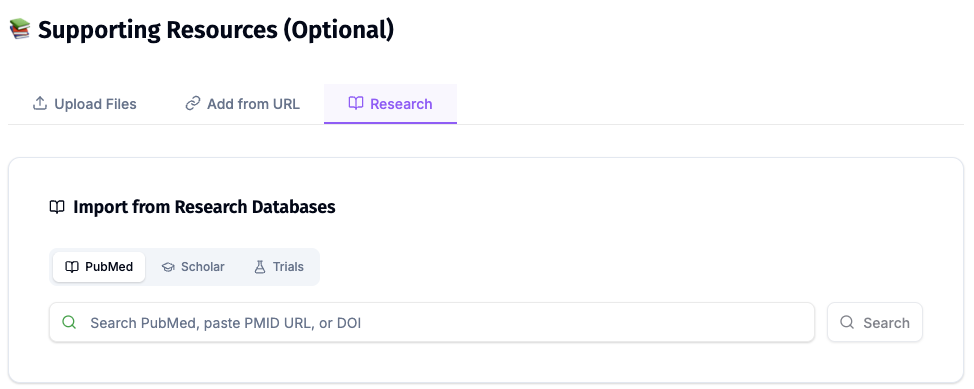
ChatSlide's Research tab connects to the databases physicians use daily:
- PubMed: Search by keyword, PMID, or DOI. Find the landmark trials, recent publications, and clinical guidelines relevant to your case. The AI reads abstracts and incorporates key findings into your slides with citations.
- Google Scholar: When your topic spans disciplines — say, the intersection of genetics and oncology — Scholar captures the broader academic literature that PubMed alone might miss.
- Clinical Trials (NCT): Presenting on a treatment where pivotal trials are ongoing? Search by NCT number or condition to pull trial design, endpoints, and status into your slides.
For a longevity or metabolic-health talk, this matters more than usual: it is a field where claims travel fast and evidence lags. Pulling fasting-insulin, ApoB, CRP, or lifestyle-intervention findings straight from the primary literature keeps a keynote credible and lets you separate established physiology from emerging hypothesis on the slide itself.
Tips for Longevity & Metabolic Health Presentations
- Lead with the gap. Open on healthspan versus lifespan before any mechanism — it earns the audience's attention and frames everything that follows.
- One mechanism per slide, paired with its lever. Resist the urge to put the whole metabolic cascade on a single slide. Show one link, then the action that changes it.
- Make biomarkers visual. Reference ranges, trend lines, and labeled panels beat raw numbers. Let the chart carry the data.
- Calibrate to the room. The same content needs different slides for clinicians, coaches, and patients. ChatSlide's chat assistant can re-level a deck for a new audience in seconds.
- Cite as you go. In a hype-prone field, visible citations are a credibility multiplier — use the Research tab rather than asserting.
- End on the practical. Close on the levers — sleep, movement, nutrition, stress, and the markers to track — so the audience leaves with something to do, not just something to know.
Note on patient data: ChatSlide's standard plans are not a HIPAA-covered service — keep PHI out of slide content and uploads. Use composite or de-identified cases in any talk that draws on real patients. For hospital systems, group practices, and clinics that need a Business Associate Agreement, our Enterprise plan offers HIPAA-compliant deployment options — contact us to discuss BAA terms, SSO, and on-prem / private-cloud hosting.
Get Started
A longevity or metabolic-health talk lives or dies on whether a mixed audience can follow the journey from mechanism to action. ChatSlide handles the structure and formatting so you can spend your time on the science and the story — turning a dense, multi-layered topic into a clean, cited, healthspan-driven deck in minutes instead of an evening.
Create your longevity and metabolic health presentation with ChatSlide — start from a topic, a research paper, or your existing notes, and let the AI build the first draft for you to refine.