
Quick Answer: A 45-minute medical grand rounds talk follows: (1) Case presentation — HPI, PMH, exam, labs, imaging (build suspense; don't reveal the diagnosis yet), (2) Differential diagnosis + reasoning, (3) Diagnostic workup that led to the answer, (4) Disease overview — epidemiology, pathophysiology, current evidence (PubMed 5–10 key papers), (5) Management + evolving therapies (cite ongoing NCT trials), (6) Case resolution + take-home pearls. Target 25–35 slides. ChatSlide has built-in PubMed + ClinicalTrials.gov import — paste PMIDs or NCT IDs and references format automatically in AMA or Vancouver style.
Grand Rounds Deserve Better Tools
Grand rounds are the cornerstone of medical education in teaching hospitals. A well-prepared grand rounds talk synthesizes clinical experience with current literature, teaches the audience something new, and sparks discussion that improves patient care.
But preparing one takes significant time. A typical grand rounds presentation requires reviewing 10-20 published papers, summarizing clinical trial data, building a case narrative, and creating polished slides — all while managing a full patient load. Residents and fellows often spend entire weekends preparing a single talk.
The tools physicians have available do not help. PowerPoint is a blank canvas. Generic AI presentation tools do not understand clinical medicine. And none of them connect to the research databases physicians actually use.
What Makes Grand Rounds Different
Grand rounds presentations have specific conventions that generic tools miss:
Case-Based Structure: Most grand rounds begin with a clinical case — patient presentation, workup, differential diagnosis, management, and outcome. The literature review then contextualizes the case within current evidence.
Dense Citation Requirements: Every clinical claim needs a citation. A grand rounds talk on emerging treatment approaches might reference recent randomized controlled trials, meta-analyses, and society guidelines — all with proper citations.
Mixed Audience: Grand rounds attendees range from medical students to department chairs. The presentation must be accessible to learners while substantive enough for experts.
Evidence Hierarchy: Physicians think in terms of evidence levels. Randomized controlled trials carry more weight than case series. Meta-analyses are more compelling than individual studies. A good grand rounds presentation reflects this hierarchy.
How ChatSlide Handles Clinical Presentations
Direct Research Database Access
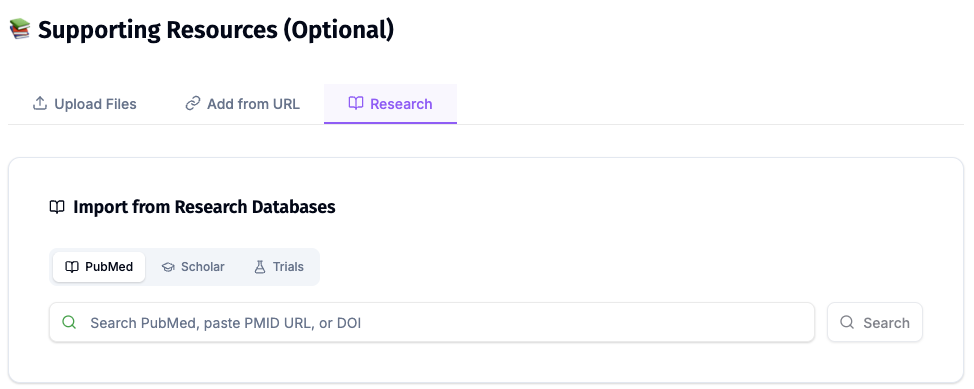
ChatSlide's Research tab connects to the databases physicians use daily:
-
PubMed: Search by keyword, PMID, or DOI. Find the landmark trials, recent publications, and clinical guidelines relevant to your case. The AI reads abstracts and incorporates key findings into your slides with citations.
-
Google Scholar: When your topic spans disciplines — say, the intersection of genetics and oncology — Scholar captures the broader academic literature that PubMed alone might miss.
-
Clinical Trials (NCT): Presenting on a treatment where pivotal trials are ongoing? Search by NCT number or condition to pull trial design, endpoints, and status into your slides.
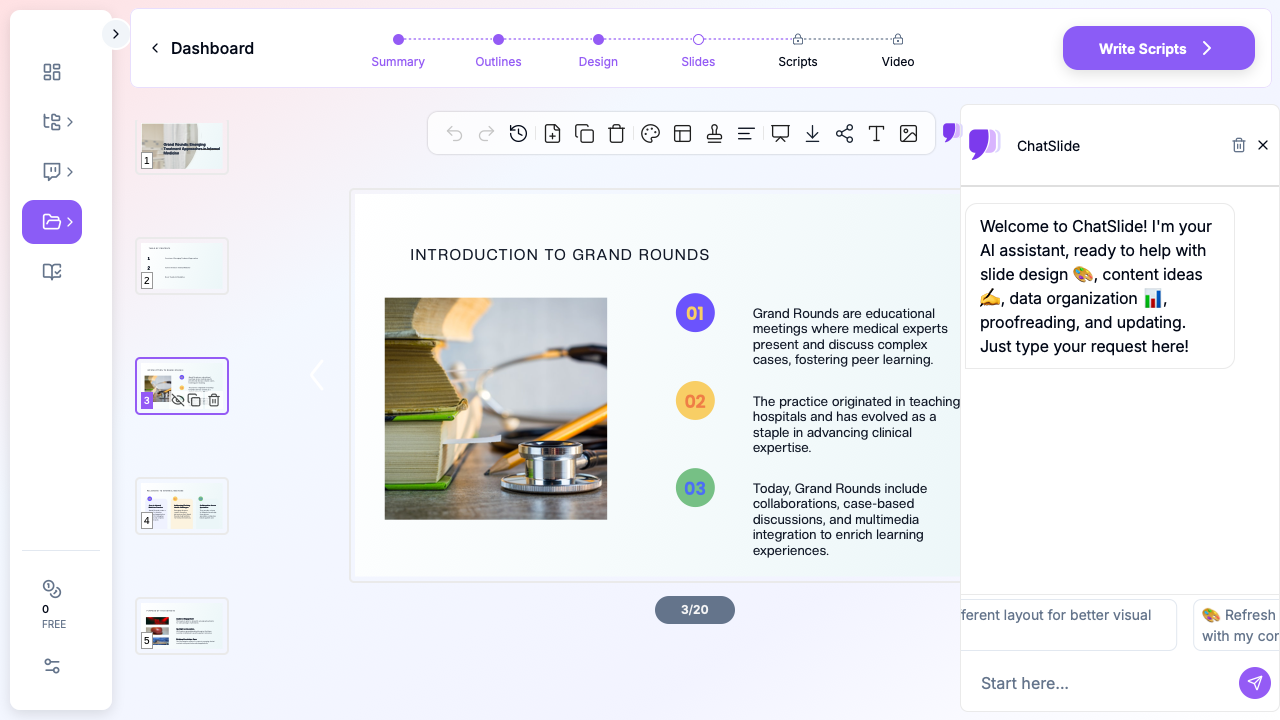
Clinical Narrative Structure
When you specify a grand rounds or conference presentation, ChatSlide generates slides that follow clinical convention:
- Case Presentation — chief complaint, history, examination, initial workup
- Differential Diagnosis — organized by system or likelihood
- Diagnostic Workup — imaging, labs, pathology with logical sequencing
- Literature Review — current evidence on the condition or treatment
- Management and Outcome — treatment decisions tied to evidence
- Teaching Points — key takeaways for the audience
Citation-Rich Content
Because you import research directly from PubMed, your slides reference actual published studies. Instead of generic bullet points about "recent studies show...", your presentation cites specific authors, journals, and years — the level of rigor grand rounds audiences expect.
Common Grand Rounds Formats
Traditional Case-Based Grand Rounds
The classic format: present a compelling case, then discuss the evidence behind your clinical decisions. A neurosurgeon presenting on AI in surgical planning, for example, can import recent publications from PubMed on surgical robotics, computer-assisted surgery, and AI-driven diagnostics.
Workflow:
- Start with your case topic and audience (physicians, residents)
- Import 5-10 key PubMed articles on the condition and treatment
- Generate slides with clinical narrative structure
- Customize with your actual case details (de-identified)
- Add imaging and pathology findings manually
Journal Club Presentations
Journal club demands a detailed critique of a single paper or comparison of several studies. ChatSlide helps by importing the paper(s) from PubMed, then generating slides that cover:
- Study design and methodology
- Patient population and inclusion criteria
- Primary and secondary endpoints
- Results and statistical significance
- Limitations and clinical applicability
Morbidity and Mortality (M&M) Conference
M&M presentations focus on adverse outcomes and systems-level learning. While the case details are institution-specific, ChatSlide can help structure the evidence review portion — importing literature on complication rates, risk factors, and prevention strategies from PubMed.
Department-Specific Rounds
Specialty rounds — cardiology conferences, tumor boards, psychiatry case conferences — each have their own conventions. Specify your specialty and scenario type, and ChatSlide adapts the structure accordingly.
A cardiologist presenting on SGLT2 inhibitors can search PubMed for the landmark DAPA-HF and EMPEROR-Reduced trials, import the key outcomes, and generate slides that contextualize these results for clinical practice.
For Residents and Fellows
Medical residents and fellows present at grand rounds, morning report, case conferences, and journal clubs constantly. The preparation time adds up.
Morning Report: Quick 15-minute case presentations with teaching points. Search PubMed for the key diagnostic criteria or treatment guidelines, and generate focused slides in minutes.
Case Conference: Weekly case discussions with literature review. Import the 3-5 most relevant studies and build a structured presentation that balances clinical narrative with evidence.
Research Presentations: Present your research findings at departmental meetings or research days. If your work involves a literature review component, import your references from PubMed and let ChatSlide structure the background section.
Board Review Sessions: Teaching sessions organized around board-style questions. Import clinical guidelines and evidence-based management algorithms to create educational slides for your peers.
Tips for Effective Grand Rounds Slides
Lead with the clinical question. Your audience needs to know why this case matters within the first two slides. Frame the literature review around answering a specific clinical question raised by the case.
Cite judiciously. Not every slide needs five references. Focus citations on the claims that are most critical or most likely to be questioned.
Use the evidence hierarchy. When multiple studies address the same question, present the highest-quality evidence first. ChatSlide helps by importing studies with their study design information intact.
Leave room for discussion. Grand rounds should provoke questions. Include slides that present genuine clinical uncertainty or areas where the evidence is evolving.
Keep it to 40-50 minutes. Respect your colleagues' time. ChatSlide's structured output helps you cover the essential content without overloading the presentation.
Get Started
Hospital physicians, residents, and fellows are using ChatSlide to prepare grand rounds, journal clubs, and case conferences faster — with built-in access to PubMed, Google Scholar, and clinical trial data.
Build your next grand rounds presentation at chatslide.ai. Import your first PubMed citation and see how research becomes a presentation.
A note on patient data and HIPAA. ChatSlide's standard plans are not a HIPAA-covered service — keep PHI out of slide content, prompts, and uploads. For hospital systems, group practices, and clinics that need a Business Associate Agreement, our Enterprise plan offers HIPAA-compliant deployment options — contact us to discuss BAA terms, SSO, and private-cloud or on-prem hosting.