
Quick Answer: To turn PubMed papers into a presentation: (1) export the paper as PDF (PubMed → "Cite" → save full PDF), (2) feed it to an AI tool that does OCR + reference extraction, (3) the tool builds the IMRaD structure (Introduction, Methods, Results, Discussion) with auto-formatted Vancouver citations. ChatSlide has built-in PubMed search + ClinicalTrials.gov NCT lookup + Google Scholar import — paste a PubMed ID or NCT identifier and it pulls the abstract, methods, and outcome data directly. A grand-rounds talk that referenced 15 papers now takes 5 minutes instead of an evening.
The Gap Between Research and Presentation
Every clinical researcher knows the routine. You spend weeks reviewing literature on PubMed, tracking clinical trials on ClinicalTrials.gov, and compiling findings from Google Scholar. Then comes the presentation — and suddenly you are manually copying citations, reformatting data, and building slides from scratch.
The disconnect between research databases and presentation tools costs researchers hours of valuable time. A single grand rounds talk might reference 15-20 PubMed articles. A conference poster draws from dozens of Google Scholar results. A clinical trial update needs accurate NCT identifiers and outcome data.
What if your presentation tool could pull directly from these research databases?
Built-In Research Database Integration
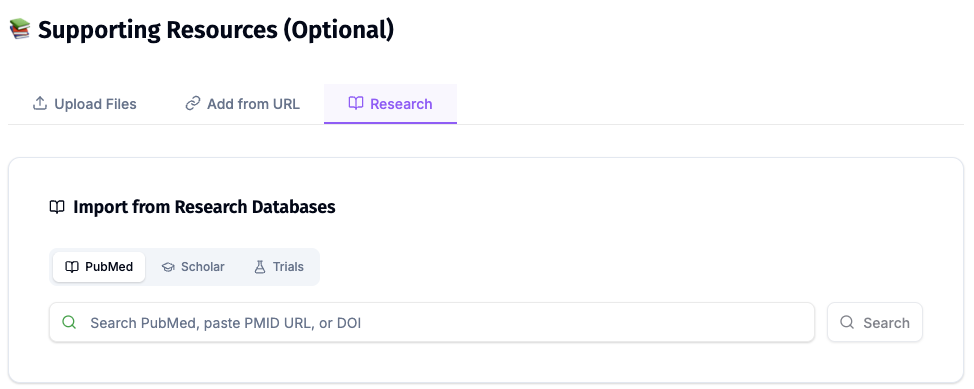
ChatSlide connects directly to the research databases clinicians and researchers use every day. Instead of switching between PubMed, your reference manager, and your slide editor, you work from a single interface.
PubMed Integration: Search PubMed directly within ChatSlide. Paste a PMID URL or DOI, or search by keyword to find relevant articles. The AI reads the abstract, key findings, and methodology, then incorporates the evidence into your slides with proper citations.
Google Scholar: Access the broader academic literature through Google Scholar search. Find systematic reviews, meta-analyses, and cross-disciplinary research without leaving your presentation workspace.
Clinical Trials (NCT): Pull data from registered clinical trials. Whether you are presenting interim results, comparing treatment arms, or reviewing trial protocols, the Trials tab lets you search and import trial information directly into your slides.
How Researchers Use This in Practice
Literature Review Presentations
For journal clubs and literature review sessions, the PubMed integration transforms your workflow. Instead of manually summarizing each paper, you search for your topic, select the most relevant studies, and ChatSlide generates slides that highlight key findings, methodology, and clinical implications.
A nephrologist preparing a talk on fluid management in CKD patients can search PubMed for recent guidelines, import the most cited studies, and have structured slides ready within minutes — complete with proper citations and evidence levels.
Conference Presentations
Medical conferences demand precision. Every claim needs a citation, every statistic needs a source. When you import research directly from PubMed or Google Scholar, the AI maintains the connection between your claims and their sources.
Pharmaceutical researchers presenting on biologic therapies at conferences like ASH or ASCO use this workflow to build evidence-rich presentations. Search for your drug target or mechanism of action, import the relevant papers, and let ChatSlide structure the narrative around the evidence.
Clinical Trial Updates
The Trials tab is purpose-built for presenting clinical trial data. Search by condition, intervention, or NCT number. When presenting at investigator meetings or site initiation visits, pull the trial protocol, inclusion criteria, and outcome measures directly into your slides.
This is particularly valuable for multi-site trials where different teams need consistent presentations of the same trial data.
Grand Rounds and Case Presentations
Hospital grand rounds require a blend of clinical narrative and supporting evidence. A surgeon presenting on AI applications in medicine can search PubMed for recent publications, import key studies on surgical robotics or diagnostic AI, and build a presentation that bridges clinical experience with published evidence.
Step-by-Step: Research to Presentation
1. Start With Your Research Question
Create a new project in ChatSlide and enter your clinical or research topic. The AI uses your topic to suggest an evidence-based outline appropriate for your audience — whether that is fellow researchers, medical students, or a clinical team.
2. Import Supporting Evidence
Click the Research tab in the Supporting Resources section. You will see three tabs:
- PubMed — Search by keyword, paste a PMID URL, or enter a DOI
- Scholar — Search Google Scholar for broader academic literature
- Trials — Search ClinicalTrials.gov by condition, intervention, or NCT number
Select the studies most relevant to your presentation. The AI reads the abstracts and key findings to inform your slide content.
3. Generate Evidence-Based Slides
ChatSlide creates slides that integrate the imported research naturally. Key findings become bullet points with citations. Study designs inform the presentation structure. Outcome data gets formatted into clear, presentation-ready formats.
4. Review and Customize
Every slide is fully editable. Adjust the emphasis on specific studies, add your own clinical observations, or reorganize sections to match your presentation flow. The AI-generated content serves as a strong starting point that you refine with your domain expertise.
5. Export and Present
Download your presentation as PowerPoint for offline use, or present directly from ChatSlide. All citations remain intact, giving your audience confidence in the evidence behind your claims.
Beyond Individual Papers: Building Evidence Narratives
The real power of integrated research databases is not just importing individual papers — it is building coherent evidence narratives. When you import multiple studies from PubMed, the AI can identify themes across them:
- Converging evidence from different study designs supporting the same conclusion
- Contradictory findings that warrant discussion and clinical judgment
- Gaps in the literature where further research is needed
- Clinical implications that emerge from synthesizing multiple sources
This is the difference between a presentation that lists studies and one that tells a compelling evidence-based story.
Who Benefits Most
Clinical Researchers: Turn months of literature review into a structured conference presentation in hours, not days. Import your PubMed search results directly and let the AI organize the narrative.
Medical Educators: Create lecture materials that reference current literature. Update slides each semester by importing the latest publications on your teaching topics.
Residents and Fellows: Prepare grand rounds, case conferences, and journal club presentations faster. The PubMed integration helps you find and cite supporting literature without context-switching between tools.
Pharmaceutical Professionals: Build evidence dossiers and conference presentations that accurately represent the clinical evidence. Import trials by NCT number to ensure precision.
Nursing Educators: Create evidence-based training materials. Search PubMed for clinical guidelines and best practices, then generate teaching slides that connect nursing protocols to the underlying research.
Direct Research Database Access
ChatSlide's Research tab connects to the databases physicians use daily:
- PubMed: Search by keyword, PMID, or DOI. Find the landmark trials, recent publications, and clinical guidelines relevant to your case. The AI reads abstracts and incorporates key findings into your slides with citations.
- Google Scholar: When your topic spans disciplines — say, the intersection of genetics and oncology — Scholar captures the broader academic literature that PubMed alone might miss.
- Clinical Trials (NCT): Presenting on a treatment where pivotal trials are ongoing? Search by NCT number or condition to pull trial design, endpoints, and status into your slides.
Get Started
Clinical researchers and medical professionals are already using ChatSlide to bridge the gap between research databases and presentations. The PubMed, Google Scholar, and Clinical Trials integrations are available on all plans.
Try it at chatslide.ai — import your first PubMed article and see how quickly research becomes a polished presentation.
A note on patient data and HIPAA. ChatSlide's standard plans are not a HIPAA-covered service — keep PHI out of slide content, prompts, and uploads. For hospital systems, group practices, and clinics that need a Business Associate Agreement, our Enterprise plan offers HIPAA-compliant deployment options — contact us to discuss BAA terms, SSO, and private-cloud or on-prem hosting.