
Quick Answer: ChatSlide turns an ROP teaching brief into a complete, cited lecture deck in under two minutes. Type a prompt ("30 slides on retinopathy of prematurity for pediatricians and obstetricians"), upload your unit's screening protocol, or paste a guideline PDF, and it produces an outline you can reorder, slides with matched imagery, speaker notes, and references pulled straight from PubMed and ClinicalTrials.gov. Used by teams at 750+ universities. Export to PowerPoint, PDF, or Google Slides. Free to start, no card required.
The Problem With Teaching ROP Outside Ophthalmology
Retinopathy of prematurity is one of the few conditions where the people who prevent it, the people who screen for it, and the people who treat it sit in three different departments. A retina surgeon knows zone, stage, and plus disease cold. The neonatologist controls the oxygen. The pediatrician sees the baby at the follow-up visit where a missed appointment becomes a detached retina. The obstetrician counsels the family before any of it happens.
So the lecture that actually changes outcomes is almost never a subspecialty talk. It is a cross-specialty talk, which is harder to build: you have to define ICROP vocabulary from scratch, justify the screening thresholds without drowning the room in trial data, and land one operational message about follow-up, all inside a conference slot that someone will cut to 25 minutes on the day.
That deck takes an evening to assemble by hand, mostly spent hunting for a clean staging diagram and re-checking which guideline version your unit follows. ChatSlide builds the first full draft of it in under two minutes, with the citations attached, so the evening goes into the clinical judgement instead.


What Makes ChatSlide Powerful for ROP Teaching
Tell it the audience, and the altitude changes
The same topic generates differently for "second-year pediatric residents", "NICU nursing staff", and "ophthalmology fellows". Put the audience in the prompt and the draft arrives pitched at it — terminology defined or assumed, screening logic explained or compressed.
Tell it the slide count and the section order
If you need 30 slides with staging before treatment, say so. The outline respects the number and the sequence, which matters when you are filling a fixed congress slot rather than writing to length.
Three input modes
Start from a typed prompt, from an uploaded file (your unit's screening SOP, a guideline PDF, a draft Word outline), or from a web page. Scanned PDFs go through OCR, so an old protocol photocopy still yields usable text.
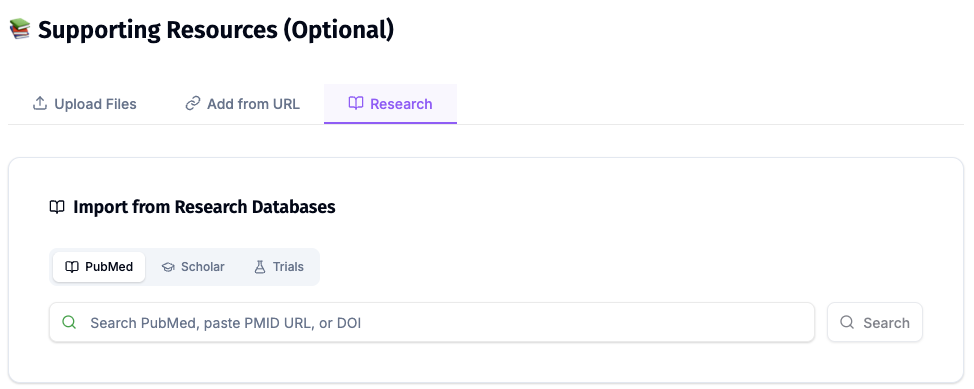
Research tab with PubMed, Scholar, and trial registries
ROP teaching lives or dies on whether the audience trusts the thresholds. Pull the primary sources in while you build, rather than reconstructing the reference list afterwards.
Editable outline before any slide is rendered
You see the section skeleton first. Drag "Zone and stage" above "Oxygen targets", delete the section on screening economics, add one on transport logistics — then generate.
Speaker notes written per slide
Useful when the lecture gets handed to a colleague, and necessary when it has to be recorded for a CME module.
19 AI editing tools inside the editor
Shorten an overfull bullet, rewrite a slide for a lay audience, convert a paragraph into a comparison table, swap an image, regenerate a single slide without touching the rest.
How ChatSlide Builds Your ROP Deck
- Give it the brief. A prompt, a file, or both. "30 slides on retinopathy of prematurity for non-ophthalmology clinicians, emphasis on screening criteria and referral timing."
- Edit the outline. Reorder sections, set the depth, cut what will not fit the slot.
- Generate slides. Layout, imagery, and speaker notes arrive together. Add citations from the Research tab where the claim needs one.
- Export. PowerPoint, PDF, or Google Slides. The PPTX stays editable, so your department template can be applied afterwards.
Use Cases Across the Perinatal Team
Neonatology in-service on oxygen and retinal outcomes. The challenge is making saturation targeting feel like a retinal decision rather than a respiratory one. Generate the physiology section, then spend your prep time on the unit's own audit numbers. Saves roughly three hours of slide building.
Pediatric residency lecture on screening criteria. Residents need the eligibility rule, the exam timetable, and the consequence of a missed visit — not the full trial history. Set the audience, cap the deck at 20 slides, done in one sitting.
NICU nursing education on exam preparation and comfort care. Dilation timing, monitoring during the exam, parental communication. The use-case prompt produces a practical deck rather than a classification lecture.
Obstetric and antenatal counselling material. A short deck on what prematurity means for vision, built for families rather than clinicians, generated in plain language from the same source material.
Fellowship-level case conference. Zone, stage, plus disease, and the laser-versus-anti-VEGF decision, with the pivotal trials cited from PubMed inside the deck.
ROP Presentation Tools Compared (2026)
| ChatSlide | Gamma | Tome | Beautiful.ai | |
|---|---|---|---|---|
PubMed / Scholar / trial-registry import | Yes | No | No | No |
Upload a protocol PDF as the source | Yes, with OCR | Partial | Partial | No |
Set exact slide count and section order | Yes | Limited | Limited | Limited |
Per-slide speaker notes | Yes | Partial | Partial | Partial |
Editable PowerPoint export | Yes | Yes | Limited | Yes |
Free tier | Yes | Yes | Yes | Trial only |
Time Comparison: Manual vs. AI-Assisted
| Task | By hand | With ChatSlide |
|---|---|---|
Outline a 30-slide cross-specialty lecture | 60-90 min | 2 min |
Draft slide text | 2-3 hours | included |
Find and format references | 45-60 min | minutes, from the Research tab |
Source and place imagery | 45 min | included |
Write speaker notes | 60 min | included |
Total | 5-7 hours | under 1 hour, mostly reviewing |
What a Strong ROP Lecture Includes
One reproducible vocabulary. ICROP terminology — zone, stage, plus disease — stated once, early, and used consistently for the rest of the talk. A handoff that says "zone II, four clock hours, stage 2, pre-plus" is actionable; "moderate ROP" is not.
The eligibility rule, stated as a rule. Gestational age, birth weight, and clinical-instability criteria as your national or society guideline defines them, with the version named on the slide. Guidelines differ by country and get revised; an undated threshold ages badly.
Oxygen framed as therapy, not a target to chase. Both prolonged hypoxaemia and excessive oxygen exposure affect retinal vascular development. The section that lands is the one that connects bedside titration to the eye, rather than restating saturation limits the unit already has on a poster.
The treatment decision, honestly. Laser and anti-VEGF each have a place; the comparison belongs on a slide, including what remains unsettled about dosing, recurrence, and long-term follow-up. Cite the trials instead of asserting a preference.
A follow-up and escalation pathway. The most consequential slide in the whole deck is usually the one naming who owns the next exam after discharge or transfer, and what happens if it is missed.
Imagery that matches the stage being described. If a figure is used to teach staging, it has to be the stage you are naming. Generic eye photography is decoration, not teaching.
Direct Research Database Access
ChatSlide's Research tab connects to the databases physicians use daily:
- PubMed: Search by keyword, PMID, or DOI. Find the landmark trials, recent publications, and clinical guidelines relevant to your case. The AI reads abstracts and incorporates key findings into your slides with citations.
- Google Scholar: When your topic spans disciplines — say, the intersection of genetics and oncology — Scholar captures the broader academic literature that PubMed alone might miss.
- Clinical Trials (NCT): Presenting on a treatment where pivotal trials are ongoing? Search by NCT number or condition to pull trial design, endpoints, and status into your slides.
Best Practices
Do: name the guideline and its year on the screening slide. Define ICROP terms before using them. Keep one message per slide. Put the follow-up pathway near the end, where it is remembered. Rehearse against the shortened version of your slot, not the full one.
Don't: use real fundus images or clinical details that could identify an infant. Mix guideline versions across slides. Assume a mixed audience knows what "plus disease" means. Let a treatment preference stand without a citation.
ROP Presentations for Departments and Hospital Systems
Neonatal eye screening spans the NICU, ophthalmology, and general paediatrics, often across multiple sites with one shared protocol. The Enterprise plan adds SSO, centralised team billing, shared brand templates so every site's teaching material looks like one programme, and collaborative editing for multi-author guideline updates — contact us to scope it for your service line.
Note on patient data: ChatSlide's standard plans are not a HIPAA-covered service — keep PHI out of slide content and uploads. For hospital systems, group practices, and clinics that need a Business Associate Agreement, our Enterprise plan offers HIPAA-compliant deployment options — contact us to discuss BAA terms, SSO, and on-prem / private-cloud hosting.
Frequently Asked Questions
Can it build a 30-slide deck if I ask for exactly 30? Yes. State the number in the prompt and the outline is built to it; you can still add or delete slides afterwards.
Will it cite the screening guideline I follow? It cites what you give it. Upload your national or society guideline, or pull the reference through the Research tab, and the relevant slides carry the citation. It does not know which guideline your unit has adopted unless you say so.
How is this different from the ophthalmology conference guide? Our ophthalmology guide targets retinal-specialist conference talks — anti-VEGF in DME and AMD, OCT-driven case decks for an ophthalmic audience. This page is the cross-specialty ROP lecture: screening, staging vocabulary, and referral logic for clinicians who are not ophthalmologists.
How is it different from the pediatric medicine guide? The pediatric guide covers general paediatric and neonatal conference and grand-rounds decks. ROP screening is a specific protocol-driven topic with its own vocabulary and its own failure mode (a missed follow-up exam), which is why it has its own page.
Can I use it for NICU nursing education rather than a physician lecture? Yes, and the audience field matters here more than anywhere. See our nursing education guide for the nursing-course structure.
Can I upload our unit's screening SOP? Yes, including scanned PDFs — OCR extracts the text. The deck is then built from your protocol rather than a generic one.
Does it produce speaker notes for a recorded CME module? Yes, per slide, editable before export.
Is it free? Yes to start, with no card required. Paid plans add higher limits and the Enterprise controls described above.
Build Your ROP Lecture
Give ChatSlide the audience, the slot length, and your screening protocol, and the first full draft of a retinopathy of prematurity lecture exists before you have finished your coffee. Make your ROP presentation with ChatSlide — free to start, no card required.
Related reading: medical grand rounds presentations.