
Quick Answer: A pediatric grand-rounds or conference deck follows: (1) Clinical case — age, gestational age if neonate, presenting features, (2) Differential by age group (neonate / infant / toddler / school-age / adolescent — physiology differs sharply), (3) Weight-based dosing & age-appropriate workup, (4) Imaging or labs with reference ranges that change by age, (5) Management with family-centered communication points, (6) Outcome + parent teaching slide. Target 12–18 slides for a 15-min talk. ChatSlide accepts PubMed papers and EHR-exported case data, generates the age-stratified differential automatically, and includes a parent-facing handout export.
The Challenge of Pediatric Medicine Presentations
Pediatric medicine sits at the intersection of specialized clinical knowledge and the need for clear, compassionate communication. Whether you're presenting neonatal sepsis research at a conference, leading pediatric grand rounds, or educating parents about a rare congenital condition, your presentation must balance scientific rigor with accessibility.
Pediatricians and neonatologists face particular presentation challenges. The evidence base evolves rapidly — new diagnostic criteria, updated treatment protocols, and emerging research on conditions like neonatal sepsis, congenital disorders, and pediatric metabolic diseases require frequent slide deck updates. Building these presentations from scratch for every conference, journal club, or teaching session drains time that clinicians would rather spend with patients.
Where Pediatric Presentations Are Used
Conference Presentations and Grand Rounds
Pediatric specialists regularly present at national and regional conferences — AAP meetings, neonatal symposia, and pediatric subspecialty conferences. These talks require polished slides that present original research, case series, or clinical reviews with proper data visualization and structured arguments.
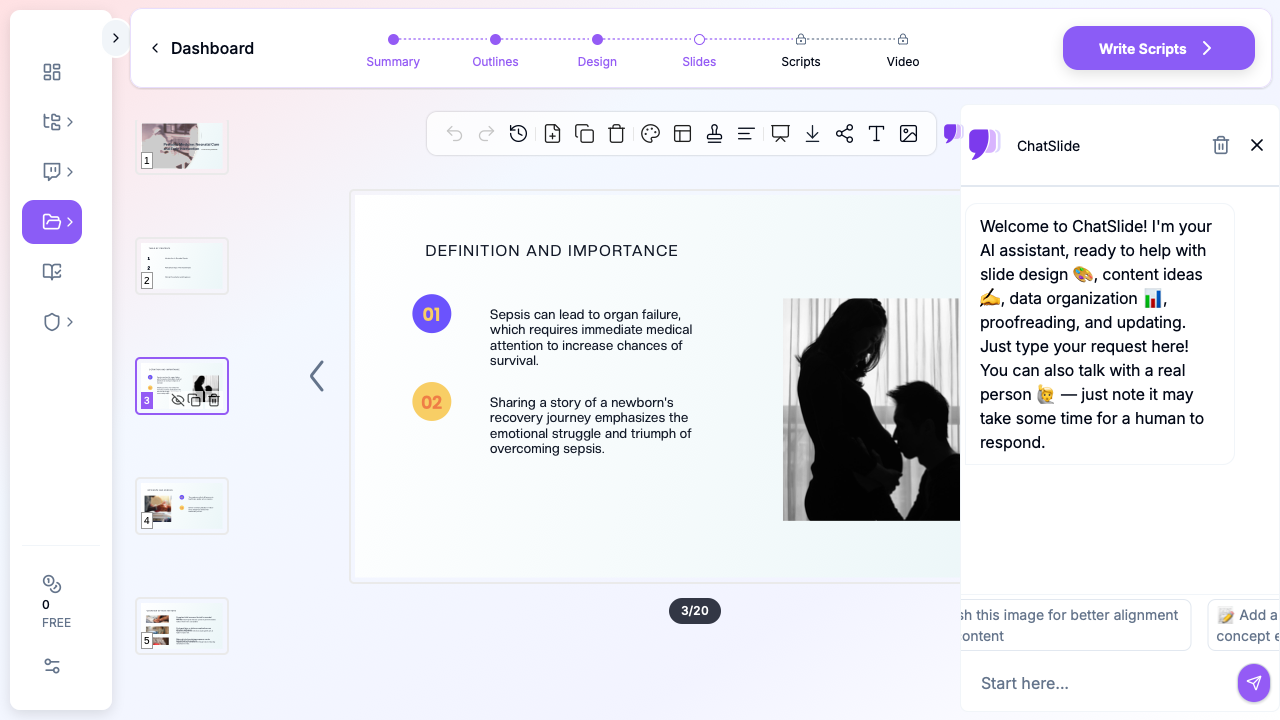
Grand rounds presentations at children's hospitals demand a similar level of rigor, often covering complex cases that span multiple subspecialties. A neonatologist presenting a case of early-onset sepsis might need slides covering microbiology, pharmacology, and developmental follow-up in a single deck.
Journal Club and Case Presentations
Pediatric residents and fellows prepare weekly journal club presentations analyzing recent publications. These require structured critique slides: study design assessment, statistical analysis review, clinical applicability discussion, and comparison with existing evidence.
Case presentations for morbidity and mortality conferences need careful organization — clinical timeline, diagnostic workup, management decisions, and outcomes — all laid out in a logical sequence that facilitates learning without compromising patient privacy.
Parent and Family Education
Pediatricians often create educational materials for parents of children with chronic conditions, rare diseases, or complex care needs. These presentations must translate medical terminology into plain language while remaining clinically accurate. A presentation about managing a child's congenital myasthenic syndrome, for instance, needs to explain neuromuscular junction physiology in terms a concerned parent can understand.
Medical Education
Pediatric faculty at medical schools and residency programs create lecture series covering child development, pediatric pathophysiology, and clinical skills. These presentations form the backbone of medical education and need to be comprehensive, evidence-based, and visually engaging enough to hold the attention of medical students during long lecture blocks.
Creating Pediatric Presentations with ChatSlide
Step 1: Specify Your Clinical Focus
Enter your pediatric topic with as much specificity as possible. Instead of "neonatal care," try "Early-onset neonatal sepsis: risk stratification, empiric antibiotic selection, and biomarker-guided therapy duration." Include your target audience — conference attendees, residents, or nursing staff — so the AI calibrates content depth appropriately.
For conference presentations, include the session format: 15-minute platform presentation, poster talk, or 45-minute invited lecture. This helps structure the slide count and content density.
Step 2: Shape the Clinical Narrative
ChatSlide generates an outline that follows standard medical presentation structure: background and epidemiology, pathophysiology, clinical presentation, diagnostic approach, management, and outcomes. Review this structure and adjust sections based on your specific angle.
For a neonatal sepsis talk, you might want to emphasize the diagnostic uncertainty section — the challenge of distinguishing sepsis from benign transitional physiology in newborns — while condensing the well-established epidemiology section that your audience already knows.
Step 3: Import Research with Built-In PubMed Search
This is where ChatSlide stands apart for medical professionals. Instead of manually downloading papers and copying key findings into slides, you can search PubMed directly inside ChatSlide. Looking for the latest neonatal sepsis biomarker studies? Search PubMed within the platform, select the relevant papers, and the AI extracts findings, citations, and data points directly into your slides.
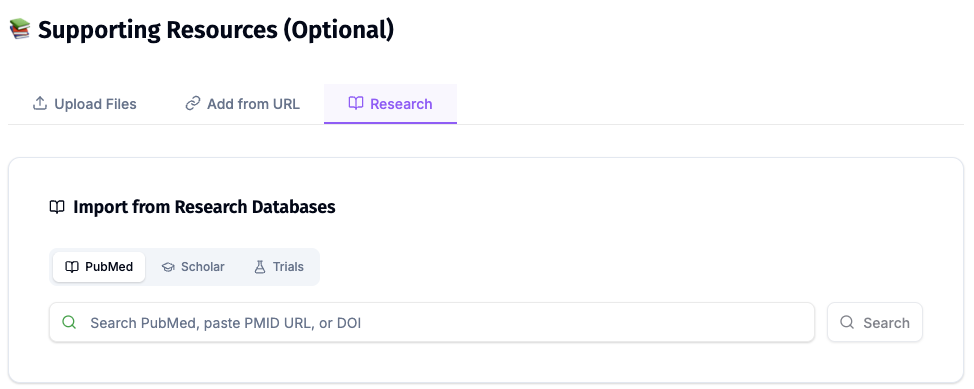
Beyond PubMed, ChatSlide also connects to Google Scholar for broader academic literature and ClinicalTrials.gov for ongoing and completed trial data. For a neonatal sepsis talk, you might pull recent RCTs from ClinicalTrials.gov alongside systematic reviews from PubMed — all without leaving the platform.
You can also upload PDFs directly — research papers, AAP clinical reports, institutional guidelines, or scanned journal articles (ChatSlide includes OCR for printed materials). The AI preserves clinical terminology from your source papers rather than oversimplifying it.
Step 4: Generate Evidence-Based Slides
The AI creates slides with structured content points for each section. For research presentations, it organizes findings logically: study objectives, methodology overview, key results, and clinical implications.
Review the generated content for clinical accuracy. While AI provides a strong structural foundation and general medical knowledge, you should verify specific drug dosages, diagnostic criteria values, and guideline recommendations against current sources like UpToDate or the latest AAP clinical reports.
Step 5: Enhance with Visuals
Add relevant medical imagery to support your clinical points. For pediatric presentations, appropriate visuals might include growth charts, diagnostic algorithm flowcharts, or clinical photography (always de-identified). ChatSlide provides stock medical imagery as a starting point that you can replace with your own clinical figures and data visualizations.
Step 6: Polish and Export
Fine-tune slide transitions and ensure consistent formatting throughout the deck. Export to PowerPoint for final customization — adding your institutional logo, adjusting to your conference's template requirements, or embedding specific data figures from your research.
Direct Research Database Access
ChatSlide's Research tab connects to the databases physicians use daily:
- PubMed: Search by keyword, PMID, or DOI. Find the landmark trials, recent publications, and clinical guidelines relevant to your case. The AI reads abstracts and incorporates key findings into your slides with citations.
- Google Scholar: When your topic spans disciplines — say, the intersection of genetics and oncology — Scholar captures the broader academic literature that PubMed alone might miss.
- Clinical Trials (NCT): Presenting on a treatment where pivotal trials are ongoing? Search by NCT number or condition to pull trial design, endpoints, and status into your slides.
Tips for Pediatric Medicine Presentations
Lead with the clinical question. Pediatric audiences respond best when they can immediately see the clinical relevance. Start with a scenario: "A 36-week infant develops temperature instability and feeding intolerance at 18 hours of life — what's your next step?"
Use age-appropriate frameworks. Pediatric medicine spans from 23-week premature neonates to 18-year-old adolescents. Make clear which age group your evidence applies to, since management can differ dramatically across the pediatric age spectrum.
Simplify complex pathophysiology. Even for expert audiences, a clear diagram of a disease mechanism is more effective than dense text. Use flowcharts for diagnostic algorithms and timelines for disease progression.
Cite current guidelines. Pediatric guidelines update frequently. Reference the specific guideline version and year (e.g., "AAP 2025 Neonatal Sepsis Guidelines") so your audience can access the source.
Respect time limits. Conference presentations are strictly timed. Build your slides for the allotted time minus two minutes for questions. For a 15-minute talk, aim for 12-13 content slides maximum.
Focus on Patients, Not Slides
Pediatric medicine presentations carry real weight — they shape how clinicians diagnose, treat, and care for the most vulnerable patients. The time you save on slide creation with ChatSlide is time you can redirect to patient care, research analysis, or mentoring the next generation of pediatricians.
Whether you're a neonatologist preparing a conference keynote on sepsis biomarkers, a pediatric resident building your first grand rounds presentation, or a pediatric educator creating a lecture series on child development, AI-powered presentation tools help you deliver your clinical message with clarity and professionalism.
Create your pediatric presentation with ChatSlide today.
A note on patient data and HIPAA. ChatSlide's standard plans are not a HIPAA-covered service — keep PHI out of slide content, prompts, and uploads. For hospital systems, group practices, and clinics that need a Business Associate Agreement, our Enterprise plan offers HIPAA-compliant deployment options — contact us to discuss BAA terms, SSO, and private-cloud or on-prem hosting.