
Quick Answer: ChatSlide is the AI presentation maker acupuncturists, physicians and integrative medicine educators use to build an acupuncture deck (a medical acupuncture talk for physician peers, a CME session on the evidence, a point-category lecture for students, a multi-day course) in under two minutes. Upload your lecture notes, course syllabus or the papers you want to present and the slides are built from those files. It is used by teams at 750+ universities and by 280,000+ professionals, searches PubMed, Google Scholar and ClinicalTrials.gov from inside the editor, respects an exact slide count, and exports to PowerPoint, PDF, Google Slides or a narrated video. Free to start, no card required.
The Acupuncture Presentation Problem
An acupuncture talk has two audiences sitting in the same room, even when only one is invited. Present to physicians and the classical framework (meridians, points, yin and yang) has to be explained without being apologised for, while every claim of benefit is held to the same evidence standard as any other intervention. Present to students and the classical framework is the curriculum, but the modern physiology and the safety rules still have to be there.
Getting that balance right is the real work, and it is slow. The literature is large and uneven: sham-controlled trials, pragmatic trials, meta-analyses that disagree, reporting quality that varies by decade. Turning it into a talk means choosing the studies, explaining why the comparator matters, and translating point locations and needling technique into diagrams that read from the back of a lecture hall.
Then the same material has to be rebuilt: a 20-minute peer talk, a two-hour CME block, a three-day introductory course with a recap at the start of each day. Each version is an evening at the keyboard.

What Makes ChatSlide Powerful for Acupuncture Decks
Your notes, syllabus or papers are the source
Upload your lecture notes, the course syllabus, a textbook chapter you are licensed to use, or the trials you plan to discuss. The deck is built from those files rather than from a generic summary of acupuncture, so the framing, terminology and point names are yours.
The audience field sets the altitude
Write "physician peers and medical specialists" and the deck leads with mechanisms, trial design and effect sizes. Write "first-year acupuncture students" and the same topic comes back as point categories, locations and technique. One field, one regeneration, same source material.
Exact slide count and section order respected
"Twenty slides, six sections, classical foundation first, then neurophysiology, then evidence, then safety" is followed as written. Review and reorder the outline before a single slide is drawn.
PubMed, Google Scholar and trial registry search inside the editor
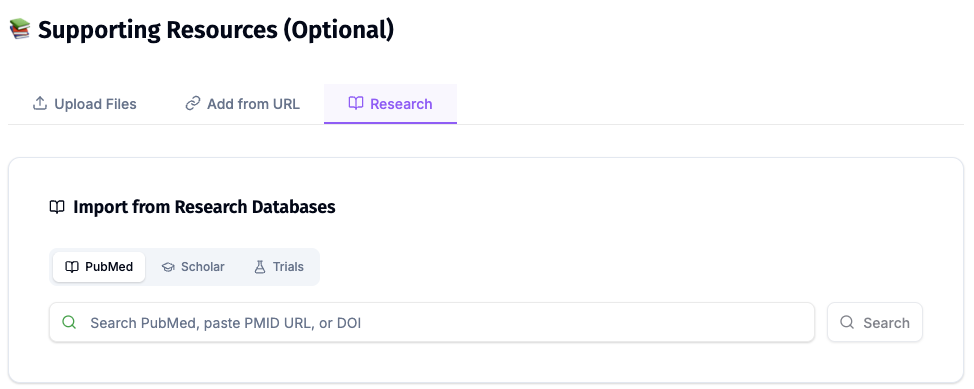
When a colleague asks "what is the comparator in that trial?", the answer should be on the slide. Pull studies by keyword, PMID or DOI from the Research tab and keep each citation attached to the slide that makes the claim.
Charts built from the numbers you supply
Upload a table of outcomes from the papers you chose and the chart is plotted from those figures. ChatSlide does not invent the data behind a chart; it plots what you give it. For an evidence talk to sceptical peers, that is the difference between a slide that survives questions and one that does not.
OCR reads scanned charts and course handouts
Point charts, older textbooks and printed handouts are often scans. OCR reads them, so their text comes through as content you can build on rather than an image you have to crop.
Speaker notes and narrated video for multi-day courses
Each slide gets speaker notes you can read aloud, and a finished deck exports as a narrated video, which suits course participants who miss a session and need the recap before day two.
How ChatSlide Builds Your Acupuncture Deck
- Upload what you already have. Lecture notes, syllabus, the papers you want to present, last year's slides, a scanned point chart, in any combination.
- Say who it is for and how long you have. "30-minute talk for internal medicine physicians, medical acupuncture as evidence-based practice, keep the classical framework as historical foundation, finish with safety and referral" is a usable instruction.
- Review the outline first. Confirm the sequence matches how you actually teach it before slides are generated.
- Generate, then verify. Slides, images and speaker notes come back together. Check every point location, needling depth, study result and citation against your sources, edit in place, then export to PowerPoint, PDF, Google Slides or a narrated video.
Use Cases for Acupuncture Presentations
Medical acupuncture talk for physician peers. Challenge: present acupuncture to specialists as an intervention judged on evidence, without discarding the classical model it grew from. Lead with the clinical question and the mechanism, then the trials, then where it fits. Saves 4–6 hours.
CME or grand rounds session on the evidence. Challenge: sham comparators, blinding, pragmatic versus explanatory designs and heterogeneous meta-analyses, explained to an audience trained to distrust weak trials. Pull the studies by PMID and build the critique slide by slide.
Point-category and technique lecture for students. Challenge: classical point categories, locations and needling technique presented clearly enough to study from. Upload the course notes and keep the terminology your programme uses.
Multi-day introductory course. Challenge: two-hour sessions over several days, each opening with a recap of the last. Ask for one deck per day with a recap section at the start of days two and three, and put references in the speaker notes.
Integrative medicine or pain service in-service. Challenge: explaining to a hospital team when acupuncture is offered, who refers, and what the safety and consent process is. Build it from your service's own referral and safety documents.
Research proposal or study design presentation. Challenge: a protocol for an acupuncture trial has to justify its comparator, blinding and outcome measures to a committee. Upload the draft protocol and build the defence around it.
Conference talk in another language. Challenge: an international audience, or a course taught in the language your students speak. Generate in any of 30+ languages from the same source files.
Acupuncture Presentation Tools Compared (2026)
| ChatSlide | Gamma | Tome | Beautiful.ai | |
|---|---|---|---|---|
Build the deck from uploaded notes, syllabus or papers | Yes | Limited | Limited | Limited |
PubMed / Google Scholar / trial registry search built in | Yes | No | No | No |
OCR for scanned point charts and handouts | Yes | No | No | No |
Charts built from the outcome data you supply | Yes | Partial | No | Template charts |
Exact slide count and section order respected | Yes | Yes | Approximate | Approximate |
Audience level controls the altitude | Yes | Approximate | Approximate | Approximate |
Speaker notes for every slide | Yes | Basic | Basic | Basic |
Export to narrated video for course recaps | Yes | No | No | No |
PowerPoint export that stays editable | Yes | Yes | Limited | Yes |
Interface languages | 30+ | Fewer | Fewer | Fewer |
Time Comparison: Manual vs. AI-Assisted
| Task | Manual | With ChatSlide |
|---|---|---|
Turn lecture notes or a syllabus into a teaching sequence | 2–3 h | 15 min |
Find, read and cite the trials for an evidence section | 2–4 h | 20 min |
Build mechanism and point-category slides with images | 1–2 h | 10 min |
Rebuild the talk for a second audience (peers vs students) | 2–3 h | 5 min |
Draft speaker notes to the time slot | 1 h | 10 min |
Total | 8–13 h | ~60 min |
Direct Research Database Access
ChatSlide's Research tab connects to the databases physicians use daily:
- PubMed: Search by keyword, PMID, or DOI. Find the landmark trials, recent publications, and clinical guidelines relevant to your case. The AI reads abstracts and incorporates key findings into your slides with citations.
- Google Scholar: When your topic spans disciplines — say, the intersection of genetics and oncology — Scholar captures the broader academic literature that PubMed alone might miss.
- Clinical Trials (NCT): Presenting on a treatment where pivotal trials are ongoing? Search by NCT number or condition to pull trial design, endpoints, and status into your slides.
What a Strong Acupuncture Presentation Includes
A clinical question first. Which patients, which condition, which outcome. A talk that starts with the history of meridians loses a physician audience before it reaches the evidence.
The classical framework, labelled as a framework. Meridians, point categories and yin and yang explained as the conceptual system the practice developed in, presented alongside the physiological explanations researchers propose, with each one named for what it is.
Mechanism slides that stay inside the evidence. Describe what experimental work suggests about peripheral nerve stimulation and central pain processing, and say plainly where the human evidence is still incomplete.
The comparator on every trial slide. Sham needling, usual care, waiting list or another active treatment: the result means something different in each case. Put the comparator next to the effect size.
Effect size in clinical terms. Whether the difference matters to a patient (sleep, function, medication use), not only whether it is statistically significant.
A safety slide. Clean needle technique, contraindications and cautions, the anatomical sites where depth matters, and what to do when an adverse event occurs. Use your training body's or regulator's guidance as the source.
Where it fits in care. Who refers, what it is offered alongside, and when it should not replace or delay effective treatment.
References in the speaker notes or on the slide. Every claim of benefit traceable to a study the audience can look up. For trials, the STRICTA reporting guideline is a useful checklist when you critique how an intervention was described.
Best Practices
Do:
- Upload your own notes, syllabus or chosen papers rather than describing the topic in one line.
- State the audience precisely: physician peers, residents, acupuncture students and patients each need a different deck.
- Ask for the classical foundation and the modern evidence as separate, labelled sections.
- Put the study design and comparator on each evidence slide.
- Verify every point location, needling depth, angle, contraindication and citation against your sources before presenting.
Don't:
- Do not let the AI supply a point location, needling depth or treatment protocol your source did not state. Check every one.
- Do not present a single trial or a single meta-analysis as settling a question the literature still debates.
- Do not describe a mechanism shown in animal models as established in humans.
- Do not put identifiable patient photographs, case details or records into a prompt or upload. Use de-identified or illustrative cases only.
- Do not reuse a course deck year after year without checking for newer systematic reviews and guideline changes.
Acupuncture Education Across a Service or Programme
Integrative medicine services, pain clinics and teaching programmes run the same material for many groups: new staff, referring clinicians, each year's student cohort. ChatSlide Enterprise adds SSO, centralized team billing, shared brand templates, and team collaboration on a single deck library, so the safety and referral deck used in one clinic is the one used in all of them — contact us to set it up.
Note on patient data: ChatSlide's standard plans are not a HIPAA-covered service — keep PHI out of slide content and uploads. For hospital systems, group practices, and clinics that need a Business Associate Agreement, our Enterprise plan offers HIPAA-compliant deployment options — contact us to discuss BAA terms, SSO, and on-prem / private-cloud hosting.
Frequently Asked Questions
Can it build a medical acupuncture talk for physicians, not just a general overview? Yes. Set the audience to physicians or medical specialists and describe the angle you want (for example, acupuncture as evidence-based practice with the classical model as historical foundation). The outline follows that instruction, and you review it before slides are generated.
Can it include the classical concepts as well as the modern evidence? Yes. Ask for both as separate sections and the deck keeps them distinct, which is usually how a mixed audience follows the argument best.
Can it find the trials for me? The Research tab searches PubMed, Google Scholar and ClinicalTrials.gov by keyword, PMID, DOI or NCT number, and keeps the citation on the slide. Choosing which studies to present, and reading them, is still your job.
Does it check point locations, needling depths or study results for accuracy? No. It builds slides from what you upload and the sources you choose, and you remain the verifier. Read every location, depth, contraindication and number against your source before teaching it.
Can I make a multi-day course with a recap at the start of each day? Yes. Ask for one deck per day with a recap section on days two and three, and ask for references in the speaker notes.
How is this different from your pain medicine and physiotherapy guides? Pain medicine covers the specialty as a whole: interventional procedures, pharmacology and multidisciplinary pain care. Physiotherapy covers rehabilitation teaching. This page is acupuncture specifically: classical foundations, mechanisms, the trial evidence and safe practice. For critiquing one paper in depth see the journal club guide, for turning a guideline into slides see the clinical practice guideline guide, and for the general clinical deck see the medical presentation guide.
Is it free? Yes, free to start with no card required. Paid plans add higher limits and more export options.
What languages does it support? The interface runs in 30+ languages, and decks can be generated in the language your audience speaks.
Get Started
Upload your notes and the papers you want to present, say who is in the room and how many minutes you have, and let ChatSlide build the first full draft while you still have time to check it against your sources.
Make your acupuncture presentation with ChatSlide → — free to start, no credit card required.