
Quick Answer: A strong nursing research / evidence-based practice (EBP) presentation follows a fixed arc: (1) a focused PICO question, (2) the search strategy and databases used, (3) levels of evidence and study designs appraised, (4) data analysis — qualitative themes or quantitative results, (5) synthesis (often a systematic-review summary table), and (6) practice implications + dissemination plan. Target 18–28 slides for a 50-minute research-course session. ChatSlide builds the draft from your topic and imports the supporting literature straight from PubMed with formatted citations, so you spend your time on critical appraisal — not slide formatting.
The Nursing Research Course Challenge
A nursing research or evidence-based practice course is unlike a clinical lecture. You are not teaching pathophysiology or a care protocol — you are teaching the process of inquiry: how to ask an answerable question, how to find and grade the evidence, how to read a methods section, and how to turn published findings into a change in bedside practice.
That makes the presentations genuinely hard to build. A single class session might cover the difference between qualitative and quantitative designs, walk through a real data-collection instrument, and then appraise a systematic review — three distinct intellectual frames in one deck. Students preparing their own scholarly project face the same wall: they have a literature review, a PICO question, and a pile of articles, and they need to present a coherent research story to faculty.
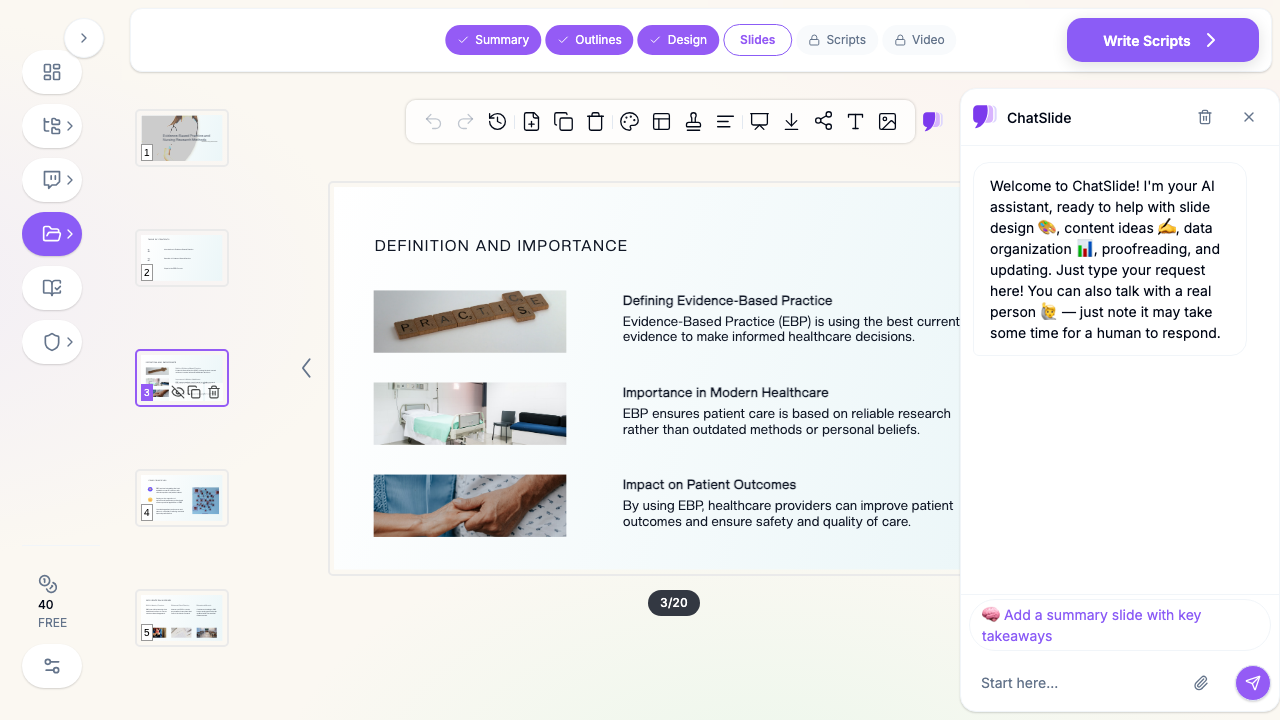
Most general AI slide tools choke here. Ask for "a presentation on data collection methods in nursing" and you get a vague, sourceless deck that confuses surveys with sampling and never mentions reliability or validity. A research presentation that gets the methods vocabulary wrong undermines the whole point of the course.
A note on scope. This guide is about the research-methods and EBP genre — the inquiry process itself. If you are building clinical-content lectures (pathophysiology, nursing interventions, NCLEX review), see our nursing education slides guide. For pure biostatistics teaching (t-tests, ANOVA, MANOVA with worked formulas), see the statistics & research methods guide. For appraising a single paper in a journal-club format, see the journal club guide. This article sits between them: the full arc from question to evidence-based recommendation.
What Makes a Strong Nursing Research / EBP Presentation
Whether you are a nurse educator teaching the course or a BSN/MSN/DNP student presenting a scholarly project, the strongest decks share the same backbone.
A genuinely answerable question. EBP presentations live or die on the PICO (or PICOT) question. Spell out Population, Intervention, Comparison, Outcome — and Time, when relevant — on a dedicated slide. A fuzzy question ("Does music help patients?") signals a weak project; a sharp one ("In hospitalized adults with anxiety [P], does a structured music-therapy protocol [I] versus standard care [C] reduce self-reported anxiety scores [O] during admission [T]?") signals rigor.
An explicit search strategy. Show the databases (PubMed/MEDLINE, CINAHL, Cochrane), the keywords and Boolean logic, and the inclusion/exclusion criteria. A PRISMA-style flow — records identified, screened, excluded, included — is the single most credible slide in any systematic-review presentation.
The right level-of-evidence framing. Use a recognized hierarchy (e.g., systematic reviews and meta-analyses at the top, then RCTs, cohort, case-control, down to expert opinion). When you present a study, name its design out loud. This is the vocabulary the course is testing.
Honest treatment of qualitative and quantitative. A common failure is treating all research as numbers. If you are presenting qualitative work, show the analysis approach (thematic analysis, grounded theory, phenomenology) and let representative themes carry the slide. For quantitative work, report the actual statistics with effect sizes and confidence intervals — not just "it was significant."
A bridge to practice. The whole reason EBP exists is to change care. End with concrete practice implications, barriers to implementation, and a dissemination plan (unit in-service, policy revision, poster). This is what separates a research presentation from a literature summary.
Step-by-Step: Building Your Presentation with ChatSlide
1. Start from your question or topic
Open ChatSlide and enter your topic. Be specific to the research frame, not just the clinical subject: "Systematic Reviews of Research Evidence for nursing students" produces a far better outline than "research." If you already have a PICO question or an assignment prompt, paste it in full — the AI uses it to structure the deck.
2. Pull the actual evidence from research databases
This is where a research presentation earns its credibility. Rather than letting the AI paraphrase from memory, import the real literature.
Direct Research Database Access
ChatSlide's Research tab connects to the databases physicians use daily:
- PubMed: Search by keyword, PMID, or DOI. Find the landmark trials, recent publications, and clinical guidelines relevant to your case. The AI reads abstracts and incorporates key findings into your slides with citations.
- Google Scholar: When your topic spans disciplines — say, the intersection of genetics and oncology — Scholar captures the broader academic literature that PubMed alone might miss.
- Clinical Trials (NCT): Presenting on a treatment where pivotal trials are ongoing? Search by NCT number or condition to pull trial design, endpoints, and status into your slides.
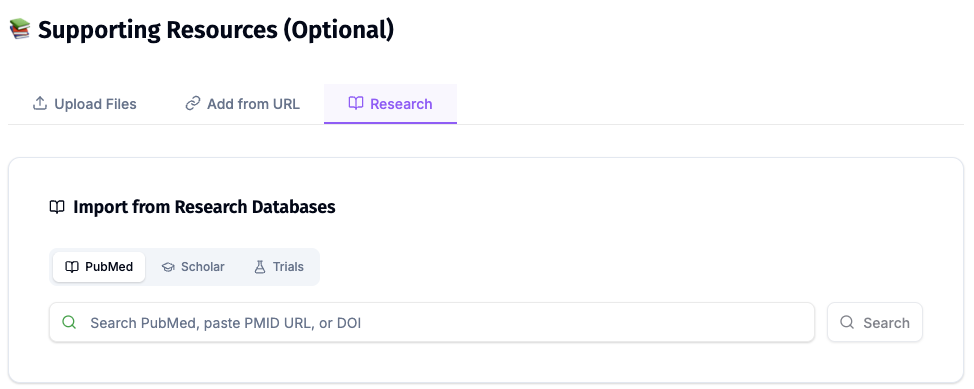
For a nursing research course this is the difference between a deck that cites "studies show…" and one that cites the actual systematic review with its PMID. Search CINAHL-style nursing topics in PubMed, pull the abstracts that match your inclusion criteria, and let ChatSlide build the evidence-summary slides with formatted references.
3. Generate and refine the outline
ChatSlide produces an editable outline first. For an EBP deck, confirm the skeleton holds the research arc: Background & Significance → PICO Question → Search Strategy → Levels of Evidence → Study Designs / Data Collection → Data Analysis (qualitative themes or quantitative results) → Synthesis → Practice Implications → Limitations → Dissemination. Drag sections to reorder; delete anything your assignment doesn't need.
4. Build the methods slides carefully
The methods section is where students lose points. Use ChatSlide to generate a clean comparison slide for qualitative vs. quantitative designs, a labeled diagram of common data-collection methods (surveys, interviews, observation, chart review, physiologic measurement), and a slide that names reliability and validity explicitly. Because every slide is editable, you can correct any term the AI gets imprecise before it ever reaches your faculty.
5. Add the synthesis table and PRISMA flow
For systematic-review presentations, ChatSlide's chart and table support lets you drop in an evidence-summary table (author, design, sample, key finding, level of evidence) and a PRISMA-style screening flow. These two visuals do more to convince a committee than a dozen bullet slides.
6. Export in your faculty's required format
Export to PowerPoint or PDF. PDF export is available on the free plan; PowerPoint and Keynote export are paid features — useful when your program requires an editable .pptx upload to the LMS.
Tips for Nursing Research & EBP Presentations
- Lead with the question, not the literature. Put the PICO slide near the front so the audience knows what every later slide is in service of.
- One study, one design label. Every time you introduce a paper, say its design (RCT, cohort, qualitative descriptive). Repetition cements the level-of-evidence vocabulary your course is grading.
- Don't bury the effect size. "Significant" is not a finding. Report the magnitude and confidence interval, and say in plain language what it means for a patient.
- Make limitations a real slide, not an apology. Naming sample size, bias risk, and generalizability limits is a sign of competence, not weakness.
- Close with a dissemination plan. EBP that never reaches the unit is incomplete. A concrete next step (in-service, policy memo, conference poster) elevates a student project to a professional one.
- Use speaker notes for the appraisal reasoning. Keep slides clean; put the why this study is strong or weak in the notes so you can speak to it without crowding the slide.
Note on patient data: ChatSlide's standard plans are not a HIPAA-covered service — keep PHI out of slide content and uploads. Research presentations should use de-identified or composite data only; never paste a real patient's chart, MRN, or identifiable details into the free or Pro tiers thinking they are covered. For hospital systems, nursing schools, group practices, and clinics that need a Business Associate Agreement, our Enterprise plan offers HIPAA-compliant deployment options — contact us to discuss BAA terms, SSO, and on-prem / private-cloud hosting.
Get Started
A nursing research or evidence-based practice presentation is a test of whether you can carry an idea from a focused question all the way to a defensible recommendation. ChatSlide handles the parts that don't deserve your time — outlining, layout, citation formatting, pulling abstracts from PubMed — so you can spend your hours on the part that does: appraising the evidence and making the case for changing practice.
Whether you are a nurse educator preparing a research-methods lecture series or a student building a scholarly-project defense, start at chatslide.ai, enter your PICO question or topic, import your evidence from the Research tab, and have a structured, cited draft in minutes.