
Quick Answer: ChatSlide is an AI pharmacology presentation maker for pharmacology lecturers, medical and nursing faculty, pharmacy educators, residents, and clinical pharmacists. It turns a drug class, a guideline PDF, or your own lecture notes into a structured deck — mechanism-of-action slides, pharmacokinetic and dosing tables, adverse-effect and interaction grids, PubMed citations, and speaker notes — and exports to PowerPoint, PDF, or Google Slides. Trusted across 750+ universities and training programs, it builds an antimicrobials or antihypertensives lecture in under 2 minutes. Free to start, no card required.
The Pharmacology Deck Problem
Pharmacology teaching repeats the same slide shapes over and over. Every drug class needs the mechanism, where it sits in the pathway, the pharmacokinetic profile, the indications, the adverse effects, the contraindications, the interactions, and the monitoring. Multiply that by antihypertensives, antidiabetics, lipid-lowering agents, antimicrobials, analgesics, anticoagulants, and the CNS drugs, and a single semester is dozens of near-identical decks that still have to be built one slide at a time.
The content is not the slow part. You already know that a thiazide is not a loop diuretic and why it matters. The slow part is rebuilding the comparison table, restating the half-life and clearance route, retyping the side-effect list, and then making the whole thing legible from the back of a lecture hall.
ChatSlide keeps the pharmacologic judgment with you and removes the assembly work.

What Makes ChatSlide Powerful for Pharmacology
Turns a drug class into a teaching arc
Start from a prompt such as "Antihyperglycemic agents for second-year medical students, 50 minutes" or "Beta-lactams: mechanism, spectrum, and resistance for a pharmacy cohort." ChatSlide builds the deck in the order pharmacology is actually taught: target and mechanism, pharmacokinetics, clinical indications, adverse effects, interactions, and monitoring.
Reads guidelines, monographs, and your own notes
Upload a guideline PDF, a review article, a drug monograph, or last year's lecture. ChatSlide extracts the thresholds, dosing rules, and recommendations into editable slides, so your updated lecture starts from your own material rather than a blank deck.
Builds drug-comparison tables
The highest-value pharmacology slide is a grid, not a paragraph: agents down the side, mechanism / onset / half-life / elimination / key adverse effect across the top. ChatSlide assembles those comparisons so a class of drugs is readable at a glance instead of buried in bullet text.
Handles pharmacokinetic charts
Paste concentration-time data, dose-response figures, or an adherence or outcome trend and ChatSlide can turn the numbers into a real chart. That matters for the slides where the curve is the teaching point — absorption and first-pass effect, steady state and loading doses, or a comparison of agents on a shared endpoint.
Searches PubMed and clinical trials
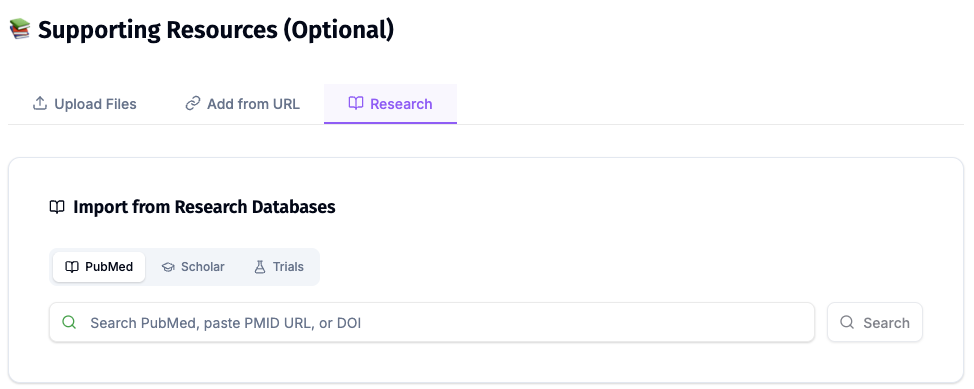
Pharmacology moves with the evidence. The Research tab pulls landmark trials, recent publications, and ongoing studies directly into the deck with citations, which is what separates a current lecture from a recycled one.
OCR for scanned tables
If your source is a photographed formulary page, a scanned dosing table, or an old teaching PDF, ChatSlide's OCR reads the text and numbers so you can edit the content rather than paste a blurry screenshot.
Speaker notes for different rooms
The same antimicrobials deck serves a nursing cohort, a pharmacy cohort, and a residency didactic. The notes can carry the depth each audience needs — administration and monitoring for one, spectrum and resistance mechanisms for another — without rebuilding the slides.
19 AI editing tools
Cut a 60-minute lecture to 25, expand one mechanism slide, rewrite for first-year students, add speaker notes, restyle to your department template, or split a dense table into two readable ones.
How ChatSlide Builds Your Pharmacology Deck
1. Name the drug class and the audience. Precision helps: "Lipid-lowering agents for internal medicine residents, 40 minutes, emphasis on statin intolerance" beats "lipids."
2. Bring your sources. Upload guidelines, review papers, monographs, or your existing slides. Keep patient identifiers out of standard-plan uploads and use fictionalized or aggregate cases.
3. Generate the outline. ChatSlide proposes the flow — mechanism, pharmacokinetics, indications, adverse effects, interactions, monitoring, cases — and you edit the sections before any slides are built.
4. Generate, review, and export. Check the drug facts and citations, adjust depth for the room, then export to PowerPoint, PDF, or Google Slides.
Use Cases for Pharmacology Educators
- Cardiovascular and metabolic classes: Build antihypertensive, antidiabetic, and lipid-lowering lectures with consistent comparison grids across the whole block.
- Antimicrobials: Turn spectrum, mechanism, and resistance into readable tables, and keep the stewardship framing intact.
- CNS and analgesia: Teach receptor targets, tolerance and dependence, and monitoring with the mechanism made visual rather than described.
- Nursing and allied-health pharmacology: Shift the emphasis to administration, monitoring parameters, and patient teaching while reusing the same source material.
- Board and exam review: Compress a semester into high-yield drug-class summaries with the comparison tables students actually revise from.
- Departments and training programs: Standardize pharmacology didactics across cohorts and sites with shared templates, SSO, centralized billing, and team collaboration.
Pharmacology AI Tools Compared (2026)
| Capability | ChatSlide | Gamma | Beautiful.ai |
|---|---|---|---|
PubMed and ClinicalTrials.gov search | Yes | No | No |
Reads guideline and monograph PDFs | Yes | Limited | No |
Builds drug-comparison tables | Yes | Manual | Manual |
OCR for scanned dosing tables | Yes | No | No |
Real charts from pasted PK data | Yes | Partial | Templates only |
Speaker notes for teaching depth | Yes | Basic | Basic |
PowerPoint and Google Slides export | Yes | Yes | Yes |
Time Comparison: Manual vs. AI-Assisted
| Task | Manual | With ChatSlide |
|---|---|---|
Outline a 40-slide drug-class lecture | 2-3 hrs | 2 min |
Build a drug-comparison grid | 45-90 min | minutes |
Summarize a therapeutic guideline | 1-2 hrs | minutes |
Chart concentration-time or outcome data | 1 hr | minutes |
Write speaker notes | 1 hr | auto-generated |
Restyle to department template | 30-60 min | one click |
Direct Research Database Access
ChatSlide's Research tab connects to the databases physicians use daily:
- PubMed: Search by keyword, PMID, or DOI. Find the landmark trials, recent publications, and clinical guidelines relevant to your case. The AI reads abstracts and incorporates key findings into your slides with citations.
- Google Scholar: When your topic spans disciplines — say, the intersection of genetics and oncology — Scholar captures the broader academic literature that PubMed alone might miss.
- Clinical Trials (NCT): Presenting on a treatment where pivotal trials are ongoing? Search by NCT number or condition to pull trial design, endpoints, and status into your slides.
What a Strong Pharmacology Presentation Includes
Mechanism before drug names. The target and the pathway come first. Once the receptor or enzyme is on the screen, the agents that act on it stop being a list to memorize and become a consequence.
One comparison grid per class. Agents down the side; mechanism, onset, half-life, elimination route, and the distinguishing adverse effect across the top. This single slide usually does more teaching than the five bullet slides it replaces.
Pharmacokinetics tied to a decision. Half-life matters because it sets the dosing interval. Renal clearance matters because it changes the dose in kidney disease. State the consequence, not just the parameter.
Adverse effects ranked by what you would act on. Separate the common-and-tolerable from the rare-and-dangerous. A slide that lists twenty side effects in one column teaches nothing about priority.
Interactions with the mechanism attached. "Avoid with a CYP3A4 inhibitor" is remembered when the slide shows why the concentration rises.
A monitoring plan. Which parameter, at what interval, and what result changes the plan. Pharmacology lectures that stop at the starting dose leave out the part clinicians use daily.
Cases that force a choice. End with two or three short scenarios where the class has to pick an agent and justify it against the comparison grid you already taught.
Related ChatSlide guides: For CNS drug development and Alzheimer's therapeutics, see the neuropharmacology and drug development guide. For thyroid, adrenal, and lipid-guideline teaching in the endocrine specialty, see the endocrinology guide. For opioid stewardship and chronic-pain therapeutics, see the pain medicine guide. This guide covers general pharmacology and pharmacotherapy teaching across drug classes.
Best Practices
- Do open each class with the target and pathway before naming agents.
- Do build one comparison grid per drug class and reuse its column structure all semester.
- Do attach a clinical consequence to every pharmacokinetic parameter you show.
- Do cite the trials and guidelines behind any recommendation that has changed recently.
- Don't paste patient-identifiable prescriptions, charts, or notes into standard-plan uploads.
- Don't list adverse effects without ranking them by what you would act on.
- Don't let a dosing table run past what is readable from the back of the room — split it.
Enterprise for Pharmacology Programs
For medical, nursing, and pharmacy schools, residency programs, and hospital education departments that need consistent teaching across cohorts and sites, ChatSlide Enterprise adds SSO, centralized/team billing, shared brand templates, and team collaboration. Contact us to discuss a department or network setup.
Note on patient data: ChatSlide's standard plans are not a HIPAA-covered service — keep PHI out of slide content and uploads. For hospital systems, group practices, and clinics that need a Business Associate Agreement, our Enterprise plan offers HIPAA-compliant deployment options — contact us to discuss BAA terms, SSO, and on-prem / private-cloud hosting.
Frequently Asked Questions
Can ChatSlide make a full drug-class lecture? Yes. Give it the class, the audience, and the length, and it builds the outline, slides, comparison tables, citations, and speaker notes, which you then edit.
Does it handle pharmacokinetics slides? Yes. It can structure absorption, distribution, metabolism, and elimination content, and turn pasted concentration-time or outcome data into real charts.
Is it useful for nursing pharmacology? Yes. The same source material can be angled toward administration, monitoring parameters, and patient teaching rather than mechanism depth.
Does it cite sources? Yes. The Research tab searches PubMed, Google Scholar, and ClinicalTrials.gov, and you can also upload papers and guidelines directly.
How is this different from the neuropharmacology guide? That guide focuses on CNS drug development and Alzheimer's therapeutics. This one covers general pharmacology teaching across drug classes — cardiovascular, metabolic, antimicrobial, analgesic, and more.
Can I use real patient data? Do not put PHI into standard ChatSlide plans. Use de-identified, fictionalized, or aggregate teaching cases unless your organization has an Enterprise deployment with appropriate BAA terms.
Can it export to PowerPoint? Yes. Export to PowerPoint, PDF, or Google Slides and finish in your institution's required template.
Is it free? Yes. ChatSlide is free to start with no card required. Enterprise is available for programs that need SSO, shared templates, centralized billing, and HIPAA-compliant deployment options.
Get Started
Build your next antimicrobials lecture, antihypertensives block, or pharmacokinetics session with ChatSlide. Name the drug class, upload your guidelines, review the citations, and export a deck your cohort can learn from. Start free at ChatSlide, no card required.