
Quick Answer: ChatSlide is an AI infectious disease presentation maker for ID fellows, hospitalists, stewardship pharmacists, infection prevention teams, and medical educators. It turns case notes, guideline PDFs, trial abstracts, antibiograms, and lecture topics into structured decks with differential tables, antimicrobial timelines, source-control algorithms, PubMed citations, speaker notes, and PowerPoint or Google Slides export. Trusted across 750+ universities and hospital training programs, ChatSlide can build an ID grand rounds deck or antimicrobial stewardship lecture in under 2 minutes. Free to start, no card required.
The Infectious Disease Deck Problem
Infectious disease presentations are rarely simple topic summaries. A strong ID case conference has to connect microbiology, host factors, exposure history, imaging, source control, drug penetration, resistance patterns, and guideline recommendations without losing the room. The audience may include ID attendings, internal medicine residents, pharmacy, infection prevention, and ICU clinicians, each looking for a different layer of the same case.
The old workflow is slow because the evidence is scattered. You pull a bacteremia guideline from one source, a trial abstract from PubMed, an antibiogram table from the hospital system, and a case timeline from your own notes. Then you rebuild the same slides by hand: fever curve, blood culture timeline, empiric versus definitive therapy, source-control checklist, duration table, and key learning points.
ChatSlide keeps the clinical judgment with you, but removes the slide assembly work.
What Makes ChatSlide Powerful for Infectious Disease
Turns cases into a clinical teaching arc
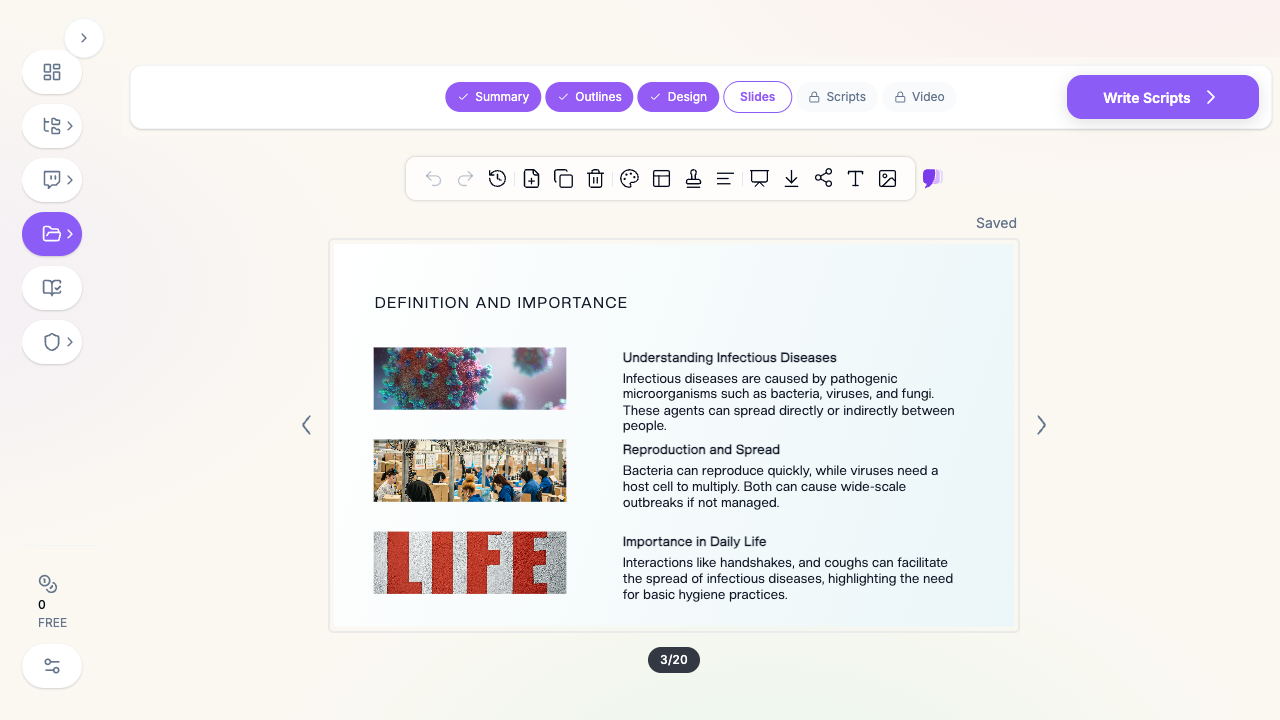
Start with a topic such as "S. aureus bacteremia: source control, echo decisions, and treatment duration" or "CNS infections in the emergency department." ChatSlide builds the deck around the real ID reasoning sequence: syndrome, host, exposure, pathogen, diagnostics, source control, antimicrobial choice, and follow-up.
Reads guidelines and papers
Upload guideline PDFs, review articles, stewardship protocols, or journal-club papers. ChatSlide extracts the key recommendations, trial endpoints, inclusion criteria, and limitations into editable slides. You can keep the deck practical for residents or deepen it for ID fellows and attendings.
Builds stewardship-ready tables
Infectious disease talks depend on tables that are easy to scan: empiric therapy by syndrome, oral step-down options, duration by source, renal adjustment notes, and red flags for escalation. ChatSlide helps assemble those comparisons so the teaching point is visible instead of buried in paragraph text.
Handles charts and lab trends
Paste de-identified fever curves, WBC trends, CRP trajectories, blood-culture dates, or antibiogram summaries and ChatSlide can turn them into visual slides. This is especially useful for bacteremia, endocarditis, sepsis, CNS infection, prosthetic joint infection, and antimicrobial stewardship presentations where timing changes the interpretation.
OCR for tables and scanned material
If your source is a scanned guideline table, a screenshot of susceptibility results, or an old teaching PDF, ChatSlide's OCR can read the text and numbers so you can edit the content rather than paste a blurry image.
Speaker notes for mixed audiences
The same deck can serve different rooms. For residents, the notes can explain why cefazolin and nafcillin are compared in MSSA bacteremia. For pharmacists, they can emphasize pharmacokinetics, renal dosing, and stewardship review points. For a hospital committee, they can focus on workflow and quality metrics.
19 AI editing tools
Shorten a case conference to 10 minutes, expand a mechanism slide, rewrite for medical students, add speaker notes, change the visual style, or turn a dense table into a cleaner comparison slide without rebuilding the deck.
How ChatSlide Builds Your ID Deck
1. Name the syndrome and audience. A precise prompt works best: "ID grand rounds on persistent MSSA bacteremia for internal medicine residents" or "antimicrobial stewardship lecture on community-acquired pneumonia for hospitalists."
2. Bring your sources. Upload guideline PDFs, de-identified case notes, PubMed papers, protocols, or an antibiogram summary. Keep patient identifiers out of standard-plan uploads, and use aggregate or fictionalized data for teaching cases.
3. Generate the outline. ChatSlide proposes the flow: clinical question, pathophysiology, diagnostic approach, evidence summary, management decisions, pitfalls, and take-home points. You can edit the sections before generating slides.
4. Generate, review, and export. Review citations and clinical wording, adjust slide depth for the room, then export to PowerPoint, PDF, or Google Slides.
Use Cases for ID Teams
- ID grand rounds: Turn a complex topic like endocarditis, CNS infection, or resistant Gram-negative infection into a structured teaching deck with evidence summaries and practical algorithms.
- Case conference: Build a timeline-based presentation for bacteremia, fever of unknown origin, prosthetic joint infection, or postoperative infection.
- Antimicrobial stewardship education: Create training decks for empiric therapy, de-escalation, oral step-down, duration, renal dosing, and audit-feedback programs.
- Infection prevention committees: Summarize outbreaks, device-associated infection trends, isolation workflows, and prevention bundles without losing the operational thread.
- Resident and pharmacy teaching: Convert a guideline or paper into a seminar with learning objectives, case questions, and speaker notes.
- Hospital networks and departments: Standardize stewardship, infection prevention, and ID consult education across sites with shared templates, SSO, centralized billing, and team collaboration.
Infectious Disease AI Tools Compared (2026)
| Capability | ChatSlide | Gamma | Beautiful.ai |
|---|---|---|---|
PubMed and ClinicalTrials.gov search | Yes | No | No |
Reads guideline and paper PDFs | Yes | Limited | No |
Builds antimicrobial comparison tables | Yes | Manual | Manual |
OCR for scanned tables and lab screenshots | Yes | No | No |
Real charts from pasted clinical trends | Yes | Partial | Templates only |
Speaker notes for clinical teaching | Yes | Basic | Basic |
PowerPoint and Google Slides export | Yes | Yes | Yes |
Time Comparison: Manual vs. AI-Assisted
| Task | Manual | With ChatSlide |
|---|---|---|
Outline a 25-slide ID grand rounds | 2-3 hrs | 2 min |
Build a bacteremia timeline | 45-90 min | minutes |
Summarize guideline recommendations | 1-2 hrs | minutes |
Create stewardship comparison tables | 1-2 hrs | minutes |
Write speaker notes | 1 hr | auto-generated |
Restyle to department template | 30-60 min | one click |
Direct Research Database Access
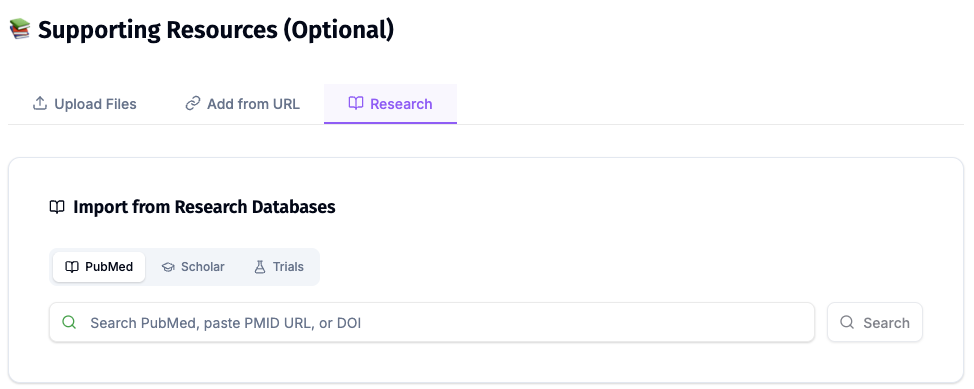
ChatSlide's Research tab connects to the databases physicians use daily:
- PubMed: Search by keyword, PMID, or DOI. Find the landmark trials, recent publications, and clinical guidelines relevant to your case. The AI reads abstracts and incorporates key findings into your slides with citations.
- Google Scholar: When your topic spans disciplines — say, the intersection of genetics and oncology — Scholar captures the broader academic literature that PubMed alone might miss.
- Clinical Trials (NCT): Presenting on a treatment where pivotal trials are ongoing? Search by NCT number or condition to pull trial design, endpoints, and status into your slides.
What a Strong Infectious Disease Presentation Includes
Syndrome before organism. Start with the clinical syndrome and host context before jumping to the bug. "Fever and altered mental status in an immunosuppressed patient" teaches a different decision tree than "Listeria meningitis."
A visible timeline. ID reasoning is temporal. Put symptoms, antibiotics, cultures, imaging, source-control procedures, and clinical response on one slide so the audience can see why the decision changed.
Diagnostics with decision points. Do not list every test. Show what each test changes: blood cultures before antibiotics, lumbar puncture timing, echo choice in bacteremia, repeat cultures, molecular testing, or imaging for source control.
Antimicrobial logic. A good therapy slide explains spectrum, penetration, resistance risk, source, patient factors, and duration. It should make de-escalation feel safer, not like an afterthought.
Source control. For abscesses, catheters, prosthetic material, endocarditis, osteomyelitis, and intra-abdominal infection, source control is often the slide that matters most. Make it explicit.
Stewardship and safety. Include renal adjustment, drug interactions, C. difficile risk, allergy clarification, therapeutic monitoring, and follow-up plans when they affect management.
Best Practices
- Do build around the clinical question, not the organism name alone.
- Do show the timeline before the evidence table.
- Do separate empiric therapy, definitive therapy, and oral step-down decisions.
- Do cite guidelines and key trials where recommendations depend on evidence strength.
- Don't paste patient-identifiable lab screenshots, notes, or imaging into standard-plan uploads.
- Don't make every slide a wall of antibiotic names. Use tables and algorithms.
- Don't skip limitations. ID audiences expect uncertainty and local susceptibility context.
Enterprise for Infectious Disease Programs
For hospital systems, stewardship committees, residency programs, and infection prevention teams that need consistent education across sites, ChatSlide Enterprise adds SSO, centralized/team billing, shared brand templates, and team collaboration. Contact us to discuss a department or network setup.
Note on patient data: ChatSlide's standard plans are not a HIPAA-covered service — keep PHI out of slide content and uploads. For hospital systems, group practices, and clinics that need a Business Associate Agreement, our Enterprise plan offers HIPAA-compliant deployment options — contact us to discuss BAA terms, SSO, and on-prem / private-cloud hosting.
Frequently Asked Questions
Can ChatSlide make infectious disease grand rounds slides? Yes. Enter the topic, audience, and desired length, then upload guidelines or papers. ChatSlide builds the outline, slides, tables, citations, and speaker notes.
Can it help with antimicrobial stewardship presentations? Yes. It is useful for empiric therapy tables, de-escalation training, duration guidance, oral step-down teaching, and stewardship committee updates.
Does it cite PubMed sources? Yes. The Research tab searches PubMed, Google Scholar, and ClinicalTrials.gov, and you can also upload papers directly.
Can I use real patient data? Do not put PHI into standard ChatSlide plans. Use de-identified, fictionalized, or aggregate teaching data unless your organization has an Enterprise deployment with appropriate BAA terms.
Can it export to PowerPoint? Yes. You can export to PowerPoint, PDF, or Google Slides and finish the deck in your hospital's required template.
Is it only for physicians? No. ID fellows, hospitalists, pharmacists, infection preventionists, nurses, residents, and medical educators can all use it.
Is it free? Yes. ChatSlide is free to start with no card required. Enterprise is available for teams that need SSO, shared templates, centralized billing, and HIPAA-compliant deployment options.
Get Started
Build your next ID grand rounds, bacteremia case conference, or antimicrobial stewardship deck with ChatSlide. Start with the syndrome, upload the sources, review the citations, and export a presentation your clinical team can use. Start free at ChatSlide, no card required.